A Professional Builds an Alienable Tool. The Rest Is Rent for Presence ===
I regularly get told why AI projects need a specific person attached to them. You have to know the nuances. You have to check the model's answers. You have to understand the domain. The conclusion is presented as obvious: every AI system needs a knowledgeable engineer permanently attached, and that participation is necessary.
I'll be honest with you — don't take it personally: in nine cases out of ten, "necessary participation" is not about engineering. It is about who collects a fee for being present.
Alienability is a standard, not a courtesy
Engineering professionalism is measured by one thing: whether you build alienable tools.
Alienable means the tool works and is maintained after its author leaves. Software written by an engineer should be easy to keep in production after that engineer quits the company. A system you built should be runnable by another team — through documentation, standards, and monitoring, not by calling you at midnight. This is not kindness toward a client. It is the basic diagnostic that separates one kind of engineering work from another.
Unfold this and you get a simple criterion: a well-built tool should remain operable after handoff; a poorly transferred one will depend on its author. Most other concerns follow from that.
"Necessary participation" is a diagnosis, not a feature
Apply the criterion to all the talk about AI.
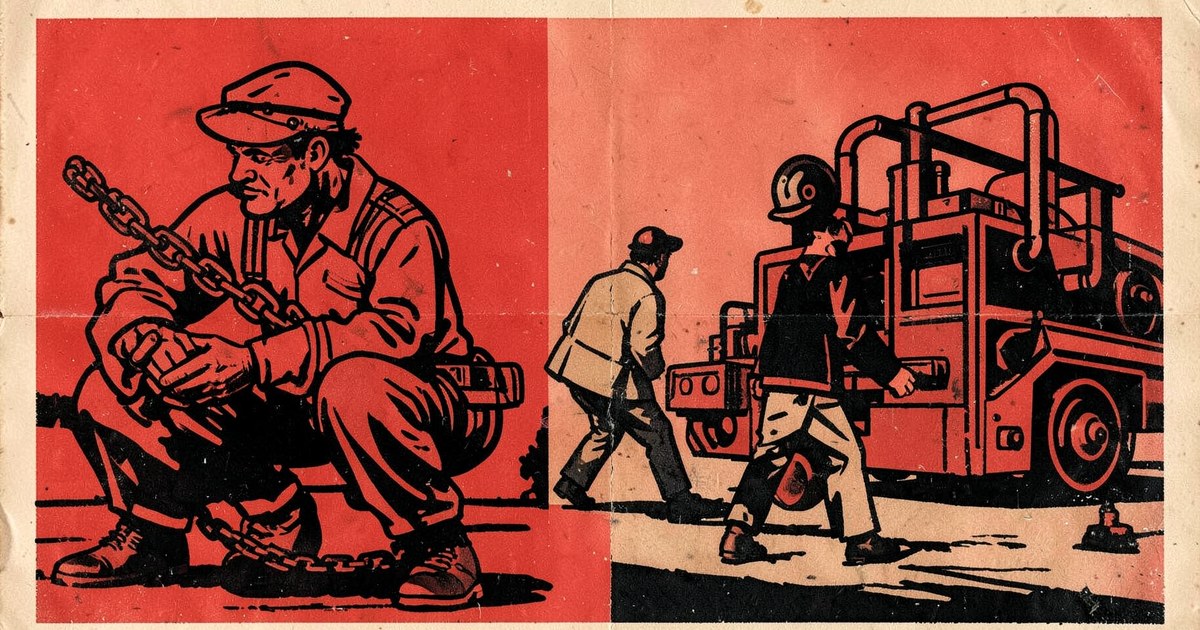
If you build a system so that the client has to keep you attached to it — the way a factory worker is attached to a machine, without which the machine stops turning — you have not built a tool. You have built a dependency and called it a tool.
There are two common explanations.
The first: you could not build it alienably. The knowledge of nuances was not extracted into documentation. The checking of model outputs was not turned into tests and gates. The domain knowledge was not encoded into standards and processes. Then "necessary participation" is a symptom of bad engineering. An honest one, but a symptom.
The second is less flattering: you could have built it alienably, but chose not to — because the client's dependence on you is the business model. As long as you stay attached to the system, the invoice for presence keeps coming. That resembles a rent-seeking arrangement. The deliverable is partly the client’s continued dependence on you, not only the system itself.
Both read identically from the outside: the client cannot tell which of the two you mean when you say "without me it won't work." And that matters, because the client is the one who decides — not you.
The client is not an idiot and reads this first
One point is often missed in these discussions.
Many clients notice this pattern quickly. A client can often distinguish a transferable system from one that depends on a single person. The talk about "you need someone constantly around or it falls apart" gets read for what it usually is — a rent request.
That affects trust. The engineer who leaves behind a team and processes that can hold delivery on their own is perceived as the architect of a system. The engineer who leaves behind dependence on one hero is perceived as a component inside the system — the kind you replace at the first opportunity. Nobody likes hiring someone they cannot later detach from. And nobody is happy about the person who sold indispensability disguised as expertise.
So do not be surprised when they are not glad to see you, and when the next contract goes to someone else. That is not the client being capricious. It is their defensive reaction to a model you proposed to them.
What delivered work looks like — versus guarded work
The practical shift is simple, and it is entirely about what happens after you leave.
The nuances you keep in your head — extract them into documentation and standards, so that an artifact holds them, not you. The checking of the model's outputs — make it reproducible: tests, gates, acceptance criteria that fire without your personal glance. The domain knowledge — encode it into processes and a roadmap, so the system can be run as a separate product with its own maintenance, not as an appendix to you.
A solid guideline: run what you build as a product with its own lifecycle — roadmap, standards, documentation, monitoring. Then after you leave, what remains is not "call the author," but a team and processes that hold the work on their own. AI systems make this problem more visible because failures, drift, and unclear ownership are harder to ignore: the more the system matters, the more important documentation, tests, monitoring, and ownership become.
The tool outlives the author — or it was rent
In this sense, engineering professionalism means building tools that can be operated and maintained without their original author. "AI does not work without a knowledgeable person" is not a property of AI. It is either a sign that the tool was built poorly, or a sign that you were kept attached to it on purpose. A client may notice this when maintenance, handoff, or renewal comes up.
Before delivery, ask one practical question: if you leave tomorrow, can another team run, monitor, and change it without calling you?