You’re Poking the Dinosaur Through the Bars. Here’s What AI Looks Like for Those Who Aren’t Afraid

The debate about what percentage of code AI should write is a conversation for the frightened. The real shift is an autonomous, continuous Agentic SDLC — and it’s closer than you think.

You're afraid to use AI for real.

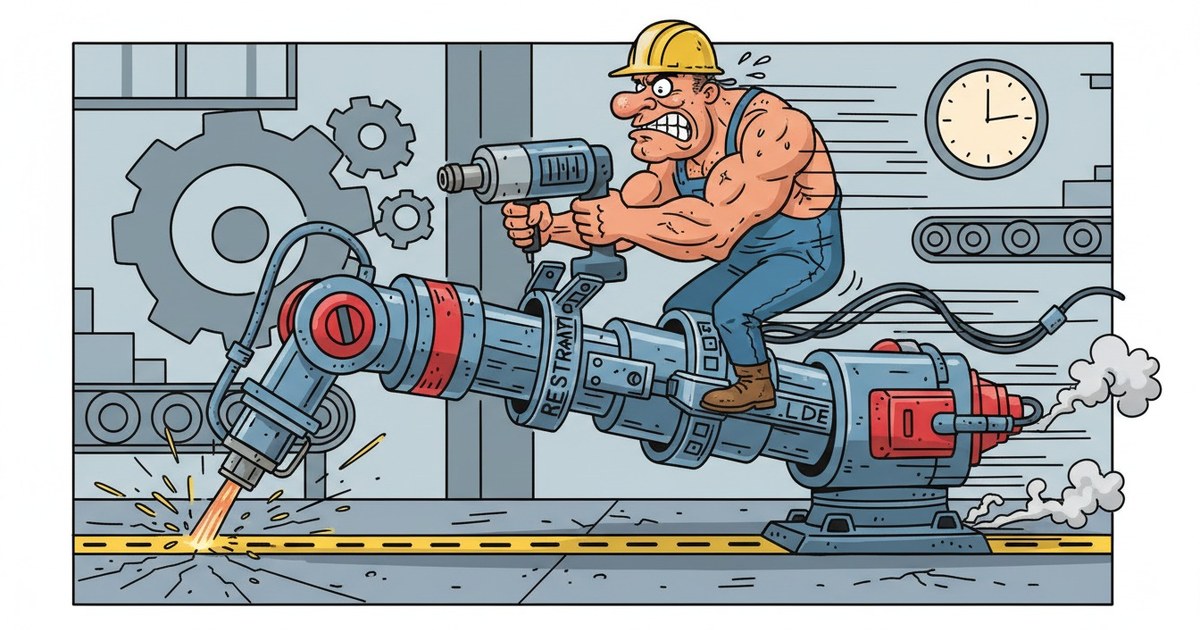
You write code with it, you build products with it, but in your mindset you're still a Siberian lumberjack who just got handed a Japanese chainsaw. You took a tool from another era and you're sawing the exact same log with the exact same motion you used with an axe. Different tool, same head.

You're poking a dinosaur through the bars at the zoo, staying at a safe distance. Wow, it can do that too — who would've thought. You look, you marvel, you walk away to argue about what percentage of your codebase was written by a neural network.

Continue reading “You’re Poking the Dinosaur Through the Bars. Here’s What AI Looks Like for Those Who Aren’t Afraid”

«AI Writes Code, but a Human Still Has to Run the Project» — No. The Entire SDLC Runs on Agents Now

Requirements, planning, infra, CI/CD, tests, monitoring — every step of the cycle, pinned to a specific tool and a production case. No human in the loop required.

I read this opinion ten times a week. Okay, the argument goes, AI can write code — fine. But to actually run a project, you need a human: talk to stakeholders, write a plan, set tasks for that same AI, configure infrastructure, Git, servers, monitoring. And surely no one is replacing the human there!

My eyes roll back every time. What?

Let me walk through the entire cycle. Step by step. At every step, I will show you not a fantasy, but a specific practice with a tool underneath it — because I have already run this cycle hands-on.

Continue reading “«AI Writes Code, but a Human Still Has to Run the Project» — No. The Entire SDLC Runs on Agents Now”

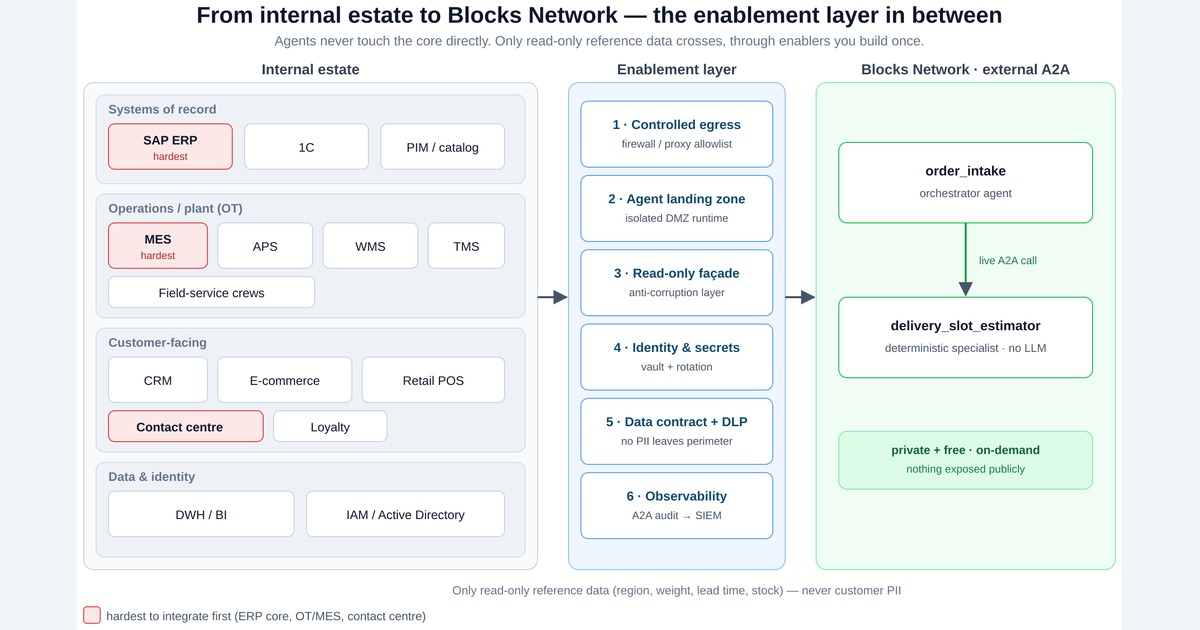
Enabling Blocks Network inside a conservative enterprise — the plumbing you have to build before an agent network is even allowed

An enablement playbook for a large, risk-averse, vertically integrated company — mapping the internal estate, naming the systems you won’t crack first, and building the egress, identity, façade and audit layers that turn “nice demo” into “approved pilot.”

The easy version of "adopt an agent network" is a demo on a laptop. The hard version is the one that pays: getting that network approved, piloted and scaled inside a big, conservative company that has a lot to lose.

Picture the archetype. A vertically integrated manufacturer-retailer: its own factories, its own warehouses and trucks, its own stores, its own contact centre. The IT estate is mature but heavy — an ERP at the core, a patchwork of line-of-business systems around it, home-grown glue holding the seams together. There is a security function with veto power, a procurement function that owns the contract, and a culture whose first instinct is "prove this won't break sales during peak season."

This is a playbook for that company. Not the marketing pitch — the actual sequence of questions you get asked, in the order you get asked them, and the honest answer to each. I'll keep the vendor's claims, the things I verified in a build, and the things that are spec-only strictly separate, because in a room like this, blurring them is how you lose the room.

Continue reading “Enabling Blocks Network inside a conservative enterprise — the plumbing you have to build before an agent network is even allowed”

Building on Blocks Network — a hands-on field report on the “Internet of Agents”

Two agents, one live agent-to-agent call, and an honest engineering read for developers, DevOps, analysts and security teams.

Every team I work with is suddenly shipping AI agents. The agents are the easy part. The hard part — the part I spent years solving for ordinary services — is the layer underneath: how does an agent built by one team get discovered, called, and governed by another, without everyone rebuilding the same plumbing and without security signing off on a free-for-all?

Blocks Network (from PubNub) pitches itself as exactly that substrate — a network for agent-to-agent communication with routing, discovery, presence and an economy layer. So instead of reading the marketing, I built on it. This is a field report from taking it from npm install to a live two-agent call, written for the four people who actually have to approve this kind of thing: the developer, the DevOps/platform engineer, the analyst/architect, and the security reviewer.

Everything below is what I observed on the real platform on a Linux box (Node v20.19.5, Blocks CLI 1.0.24). Where I couldn't verify something, I say so.

Continue reading “Building on Blocks Network — a hands-on field report on the “Internet of Agents””

Process Over Agent: How I Put an ECC Harness Through a Real Refactor

A coding agent without a harness is a fast, forgetful junior. The problem isn’t generation speed — it’s the absence of process around it.

Eighteen months ago I would have written this post about speed. About how an agent drafts in a minute what used to take me an hour. Today I'm writing it about discipline — and that shift is the whole story of the past year and a half.

I've been living in a mode where a coding agent writes a significant portion of my code for about eighteen months now. First came exhilaration, then fatigue, then a sober realization: an agent without a harness is not an engineer. It is a very fast, very forgetful junior. It can draft in a minute what would take me an hour, but in that same minute it will cheerfully take out a neighboring module, skip the tests, invent a library method that doesn't exist, and forget what we agreed on five messages ago. As a technical manager, I look at this plainly: the problem is not code generation speed. The problem is the absence of process around that generation.

Continue reading “Process Over Agent: How I Put an ECC Harness Through a Real Refactor”