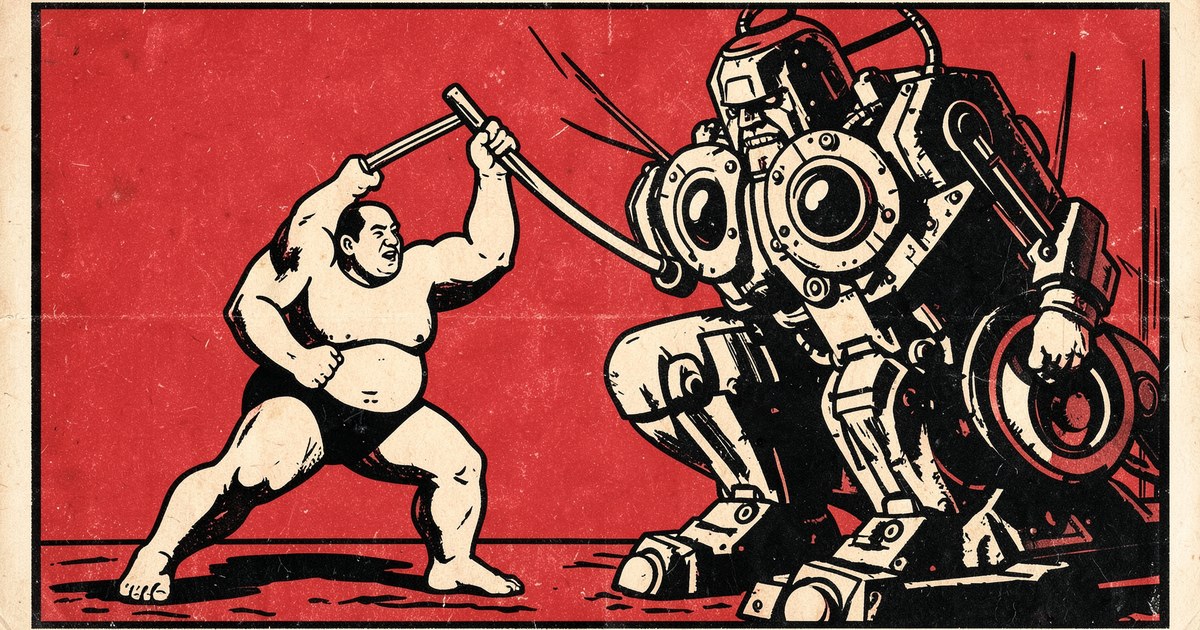
While everyone panics about finding a stable earning strategy in the age of AI — which I haven't seen work reliably yet — I keep running into one assumption I keep seeing. Generalized, it sounds like this:
"The client won't be able to use AI as professionally as a professional. As me."
The weak point in this argument is this: Here is the issue. It depends on one question.
The key question
"And why, exactly, won't they?"
From here, depending on how they justify it, the answers range from "trust me, they just won't, okay?" to more elaborate explanations. Most versions I hear still come down to that assumption.
Many practitioners rely on that assumption. As long as practitioners believe their expertise is an inalienable premium on top of the tool, they feel safe. That assumption may become costly later.
The root is in your head
The problem is in how practitioners model AI.
Practitioners defending this position perceive AI as a new tool for extending their hands and intellectual skills. They say it themselves: I built this thing with AI, and someone without my experience couldn't replicate it.
That is true if AI is treated only as an assistant to existing skill. If another person uses AI the same way — as a hand extension, as an attachment to their own skills — the result will be different. The amateur's result will be worse. The less experienced person will usually get a weaker result.
This frames the contest as one practitioner using AI better than another. Even if you pick up the same sword, I'll beat you easily.
That framing misses the main shift
A practitioner with Claude in hand is not competing with another practitioner with Claude in hand.
They are also competing with what the model can produce with minimal expert involvement.
In many tasks, that is a worse competitive position.
You can be the smartest person alive, but a model trained on large amounts of human work can outperform individuals on some repeatable tasks. This isn't a duel between two masters with identical swords — you're going one on one against the system that increasingly performs the task itself. The jedi battle ended before it started: the second jedi isn't the human across from you, it's the weapon in their hands.
The difference isn't the strength of the hand — it's removing the hand entirely
The important distinction is this:
Your competitor wins not because they're smarter or better at prompting. They may gain an advantage when they delegate more of the decision-making to the model. You use it to extend your hands and skills. They use it to make or approximate decisions that used to require specialist judgment.
They don't tell Claude how to build the pipelines. They hand over larger parts of the workflow, including planning and implementation.
They reduce their own role in the workflow. That's exactly how they bypass you: while you're proving your arm is steadier, they've removed their arm entirely — and left on the field only the model doing the operative work.
They'll simply stop competing with you
It is tempting to rely on being more experienced with the thought that you're smarter, more experienced, better-read, more battle-tested than others.
That advantage may not be enough in tasks the model can execute directly. Your position may weaken not because you lost a competition — but because others will simply stop competing with you. The thing competing with you is Claude.
That changes the basis of competition. You step into the ring, warm up your shoulders, scan for a human opponent — and across from you stands not a person. A model trained on large-scale examples of human work, and your years of workflow optimization may matter less in that setup.
This applies beyond one profession
This is not limited to less experienced practitioners — simpler practitioners, people with less experience or weaker workflows. This applies beyond one profession.
In some workflows, this shift is already visible. The relevant question is which parts of your work still require your judgment, and which parts can now be delegated to the model.