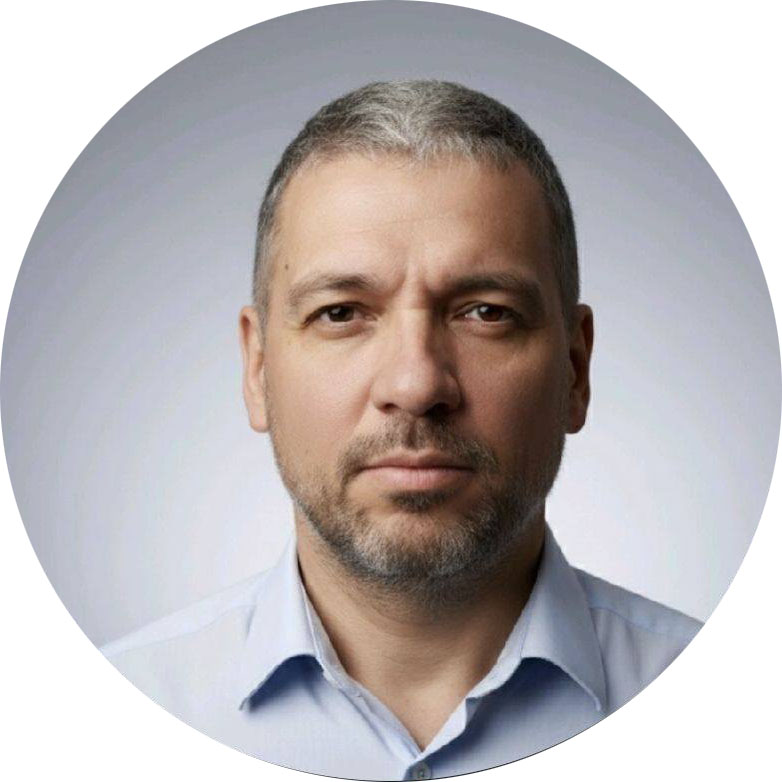
Grigoriy Dobryakov — AI-Driven Head of Engineering

AI-Driven Engineering Leadership

AI-Driven Head of Engineering

Grigoriy Dobryakov

I come into mature organizations to fix what's broken or build order out of chaos — and I build the systems that do it, out of people and agents, where AI absorbs the rote layer and people operate at judgment. Coding with AI is table stakes now; the scarce work is making the delivery and management layer AI-native, where outcomes are won or lost. I stay a hands-on engineer — I design and run these systems myself, not just describe them.

Languages: English (professional working), Russian (native)

Engineering orgs worked across
200+
Services architected
40+
User profiles on the personalization platform
199M+
Retailer revenue
$680M

Systems I build

Two AI systems in two different domains — a proven pattern, not a one-off. Coding with AI is table stakes; the scarce work is making the delivery and management layer AI-native, where outcomes are won or lost.

AI-native delivery intelligence

Built solo · running on live engagements

The system holds the full state of an engagement from the first pre-sales call: every call, email, document and commitment, captured across channels and reconciled. It weighs each fact by who is authorized to state it, keeps provenance on every claim, and flags contradictions, unkept promises and aging questions before they cost margin.

ai-delivery.dobryakov.net →

Next Move Engine

Public · self-demonstrating

An AI system that runs market intelligence and content operations end to end: reads signals, decides the next move, ships. Same engineering discipline, in the open — a live demonstration of the systems I build.

nextmoveengine.com →

And beyond that — a multi-model video pipeline (character, scenes, TTS, whisper-timed keyframes, image-to-video, camera motion) and a production-grade agent/MCP toolchain — all of it built and running in production.

Cases

Evidence, metrics, and business outcomes.

Askona — AI leadership and enterprise architecture

$680M-revenue retailer · 20+ teams · 40+ services · 15M customers

Event-driven architecture, AI in production, and team enablement—with a multi-party integration layer so independently owned teams and services stay aligned on shared contracts; integration seams are explicit, not ad hoc.

  • • Context: 15M customers, a $680M-revenue retailer, 20+ distributed teams, 40+ services; heterogeneous landscape and many system owners.
  • • Action: enterprise architecture + hands-on AI leadership; event-driven integration (Kafka/RabbitMQ/API) as the backbone between teams and services; AI bot over data lake (NL -> SQL), personally designed and trained next best offer ML model, order lifecycle timestamp tracker, AI-assisted coding in practical microservices, and dozens of training sessions for 100-200 participants each.
  • • Result: faster release cadence and time-to-market, higher reliability, lower cross-team friction, better bottleneck visibility; more predictable seams between parts of the landscape (fewer manual one-off alignments per change). AI became the primary operating pattern across all levels.
Open case

Large system integrator — turnaround and restored predictability

1500+ employees · Enterprise wins · Predictable delivery restored

An engineering department in a B2B integrator under pressure: unstable delivery, strategic contract risk, and margin pressure.

  • • Context: B2B services with a high cost of failure and rising reputation risk; VIP and large pursuits often needed engineering leadership in the sales cycle.
  • • Action: turnaround — team rebuild, quality governance, test automation scaling; VIP presales with engineering depth for sales; de-escalation of critical client situations.
  • • Result: delivery predictability and profitability, less dependence on manual heroics; enterprise accounts like Askona; presales support on major enterprise deals.
Open case

UMI.CMS/UMI.RU — transition from boxed product to SaaS

Revenue +50% · 65k → 1M+ users · Weekly releases · 70+ test environments

Rebuilt the product lifecycle and engineering processes for a scalable transition to a cloud model.

  • • Context: 65k clients → 1M+ users.
  • • Action: engineering-function turnaround — department reorganization, engineering culture adoption, QA/DevOps rollout, and test farm scaling.
  • • Result: 50% revenue growth, controlled scaling, weekly releases instead of quarterly.
Open case

PersonaClick — ML and personalization at scale

199M+ profiles · ML in production · Cashflow + retention

Modernized the personalization platform with ML and predictive analytics to remove infrastructure bottlenecks.

  • • Context: 199M+ user profiles.
  • • Action: engineering and platform evolution, ML/predictive analytics integration, bottleneck removal.
  • • Result: stronger cashflow and client retention, higher platform speed and stability.
Open case

Recommendations

From colleagues and managers on my LinkedIn profile.

"Grigoriy consistently demonstrated exceptional technical leadership and deep expertise as an Enterprise Architect. He was one of the key drivers behind the adoption of event-driven architecture and microservices across Askona's IT landscape — pragmatic, collaborative, and always focused on the right solution for both business and technology."

Aleksander Zinger · Director-level IT Business Partner, Askona

"I highly recommend him as an exceptionally competent professional in Enterprise Architecture, Solution Architecture, AI-driven innovation, and technical leadership. He led the company's strategic AI initiative, driving the adoption of AI tools and practices across the organization."

Ilya Chernov · Head of PMO IT, Askona

"He showed himself as an excellent technical leader. He put the development process to a new level, and the best practices he taught the team significantly improved the quality of the product."

Anton Prusov · CTO at Varwin — reported to Grigoriy

"One of the best experts in software development I know. His expertise in application architecture, project management and team leadership is amazing. I'm really thankful to him for being my mentor."

Aleks Volochnev · Developer Advocate — reported to Grigoriy

"Open-minded and highly communicative. His influence on people and his professionalism made the development team one of the best I know."

Sergei Rakutin · Director, Product Management (FinTech), NASDAQ

"Grigoriy has excellent skills in the Linux command line, the automated deploy processes and distributed systems management."

Oleg Petrachev · ex-CTO Sprinthost · ex-Avito — managed Grigoriy
Live MCP server dobryakov-expert

Query my profile as an MCP server

I run a production MCP server that represents my professional profile. Connect it to your Claude and query my experience directly — a live demonstration of the systems I build.

Claude Codex Cursor Streamable HTTP 7 tools
.mcp.json

https://mcp.dobryakov.net/mcp

"dobryakov-expert": {
  "type": "http",
  "url": "https://mcp.dobryakov.net/mcp"
}

Who This Is For

Different stakeholders get different, measurable value.

CEO / Founder

When you need an engineering organization where AI is the operating model — not one department's experiment — I take ownership of the whole function and free your time for strategy. An agent is a multiplier of your organization, not its competitor: without an owner who designs and owns the outcome of the whole system, agents turn into costs; with an owner, they turn into an operating model.

  • • Focus: AI as competitive advantage, not a cost center; managed growth without proportional overhead.
  • • Value: in 90 days you have a map — where AI works, where it doesn't, and who owns what.
  • • Fear removed: investing in an agent stack and a year later finding parallel pilots with no production outcome and no one accountable at the board level.

CTO / VP Engineering

When you need one person you can trust with people, AI architecture, and delivery — not two separate roles — I cover all three levels with unified accountability for production outcomes. The more mature your agent stack, the more valuable the meta-role: who decides which agents run which tasks, where to stop them, and who owns the outcome of the whole system operating as one model.

  • • Focus: delivery predictability + AI embedded in SDLC + architectural trade-offs without accumulating technical debt.
  • • Value: C-level peace of mind, less management overhead, AI in the pipeline as team practice — not one engineer's personal habit.
  • • Extra layer: owner of the agent system that performs both levels (VP Engineering + Head of AI), not just a person duplicating two roles.

Head of AI / VP AI

When the AI roadmap exists but its translation into engineering practice stalls, I bridge the gap between architectural decisions and how teams actually work every day.

  • • Focus: production readiness of AI systems, team enablement, governance, and observability of the AI layer.
  • • Value: AI initiatives reach production instead of dying in pilots.

Chief Digital Officer

When the digitalization roadmap needs to land as outcomes, I align business goals with engineering execution without losing control.

  • • Focus: AI initiative portfolio execution, transformation risk management, business–technology alignment.
  • • Value: digital projects reach production predictably.

HR / Head of Recruitment

A rare combination: engineering leadership + AI systems expertise in one profile — fills roles that would otherwise require two separate people with coordination overhead between them.

  • • Focus: lower hiring risk for a complex combined role; explicit JD fit on scale, stack, and scope.
  • • Value: a candidate who is easy to defend to CTO and CEO simultaneously.

Chief Architect

When architectural integrity must survive AI transformation, I embed new practices without breaking the foundation or creating unmanageable AI technical debt.

  • • Focus: managed architectural debt, AI solution compatibility with the existing landscape, reliable change.
  • • Value: platform growth without increasing fragility.

Expertise

AI as an operating model — not one-off prompts, but a repeatable operating layer across three dimensions: SDLC, product, and operations.

How I operate

When I take on an engineering organization, the first 90 days go into building the system — reading team & SDLC / product / operations, then wiring people and agents into one operating model with explicit owners, metrics, and stop criteria. Pilots reach production or get shut down with a reason. That's the cadence, whatever the scope.

What you get

  • AI as the operating model, not a feature — I diagnose where AI creates real leverage for your engineering organization right now, then embed it across three layers: how teams work, how the product operates, how operations use data.
  • Predictable delivery as a baseline — I start with what breaks delivery now: SDLC bottlenecks, architecture debt, organizational friction. Timelines and quality without black swans.
  • Leadership at scale — multiple teams and leads, clear ownership boundaries, growing people without diluting execution standards.
  • One person instead of two — where VP Engineering and Head of AI don't speak the same language, I cover both levels with unified accountability for business outcomes.
  • Handed problems, not plans — give me a broken org and a mandate, and I design it: the roles and what they require, who goes where, the processes, the expectations, the metrics — and I own the outcome, not the schedule. Organizational ownership, not delivery administration.
  • Owner of the human + agent system — I direct people and AI agents as one system and carry the outcome: where each piece moves, where agents give leverage, where to stop them, who answers to the board. I build the AI that absorbs the rote executor layer — tracking, reconciliation, planning — so the team works at judgment level, not manual data entry. The cheaper agent labor becomes, the more valuable this meta-role.

AI in SDLC

  • AI-assisted coding as team practice — not one engineer's personal habit, but a repeatable workflow with explicit standards and patterns handed to the whole team.
  • AI in testing and review — test case generation, defect analysis, AI in code review: faster cycle without lowering the quality bar.
  • AI-output eval as a release criterion — structured eval before every release that changes model behavior: regression set from production incidents, distribution check on real inputs, one named owner who gives the final go. AI-output quality is verified before release — not accidentally discovered in production.
  • Observability of AI in the production pipeline — model decision logging, human-in-the-loop checkpoints, audit trails; AI in production is visible and managed, not a black box.

AI in Product and Operations

  • Production-ready AI architecture — RAG with proper knowledge structure (not "dump a PDF into a vector DB"), agentic pipelines, recommendation systems; designed for real enterprise constraints: security, legacy, governance.
  • Event-driven AI — LLM as a consumer of event streams (Kafka, webhooks, monitoring alerts, CI events): intelligent event processing, not a chatbot.
  • AI in marketing and business processes — repeatable systems with measurable output, not "let's ask ChatGPT."

Stack and domains

  • AI layer: Anthropic Claude (API, MCP, tool use), OpenAI-compatible interfaces, Gemini; RAG/agentic patterns in enterprise contexts, n8n orchestration, Python + APIs.
  • AI tooling and protocols: Cursor IDE, Claude Code, MCP integrations, and tool routing for engineering and research scenarios.
  • Cloud and platform: AWS, Ansible (IaC), Docker Hub; hybrid / multi-region; virtualization and the VM layer.
  • Integration and events: Kafka, RabbitMQ, APIs, event-driven architecture.
  • Data and analytics: SQL, Elasticsearch, ELK, ClickHouse; vector stores.
  • Quality and delivery: phpunit, Cypress, CI/CD, automated testing pipelines.
  • Enterprise integrations: 1C, Bitrix, ERP / WMS / BI, SAP.

Methods

  • • AI Engineering governance: observability, prompt injection defense, data isolation, human-in-the-loop; across GDPR and EU AI Act requirements.
  • • Engineering governance and operational delivery discipline.
  • • Agile planning and execution practices (planning / review / refinement).
  • • CI/CD, test automation, quality gates, release reliability.
  • • DevOps, IaC, SRE thinking for sustainable operations.
  • • Legacy modernization with controlled architectural debt.

Why this matches market expectations

  • • I lead multiple teams and managers and build a repeatable delivery model — not heroics from individuals.
  • • AI in SDLC is not one-off prompts but a managed operating layer (governance, observability, clear ownership).
  • • Governed and auditable by design — data isolation, provenance, audit trails, human-in-the-loop. I'm across GDPR and the EU AI Act and build the controls they call for (logging, human oversight, data governance) — engineering-side conformance and awareness, not a compliance/legal role.
  • • Handed a problem, not a plan: I design the organization (roles, people, process, expectations, metrics) and own the outcome, not the schedule — organizational ownership, not delivery administration.
  • • Positioning is grounded in real production cases: Askona — multi-party integration layer, RAG and event-driven AI for a $680M-revenue retailer; PersonaClick — ML on 199M+ profiles; nextmoveengine.com — my own AI system, running the same patterns I ship for others.
  • • In high-pressure environments I keep predictability without artificially slowing growth — through prioritization and transparent trade-offs.
  • • The more mature the agent stack, the higher the value of the role shifts: not "doing things agents can't yet do," but designing the agent system and owning its outcome. This meta-role cannot be bought as a SaaS subscription with an SLA — it takes real organizational authority and someone willing to put their name on the result.

Materials

A single hub with all public assets: blogs, videos, courses, community, project, and profiles.

Blogs and Articles

Practical writing on project management, engineering leadership, software delivery, and applied AI in production contexts.

Videos and Courses

Public video materials on engineering leadership, architecture, and practical AI operations.

  • • IT Head YouTube channel (in Russian): youtube.com/@IT-Head
  • • Distributed async systems course (in Russian): playlist
  • • HR automation course (in Russian): playlist
  • • Industry interviews series (in Russian): playlist

Connect

The clearest picture of how I think is in the cases, the engineering breakdowns, and Next Move Engine, my own AI system running the same patterns I ship for others. Open work is on GitHub.

Connect on LinkedIn