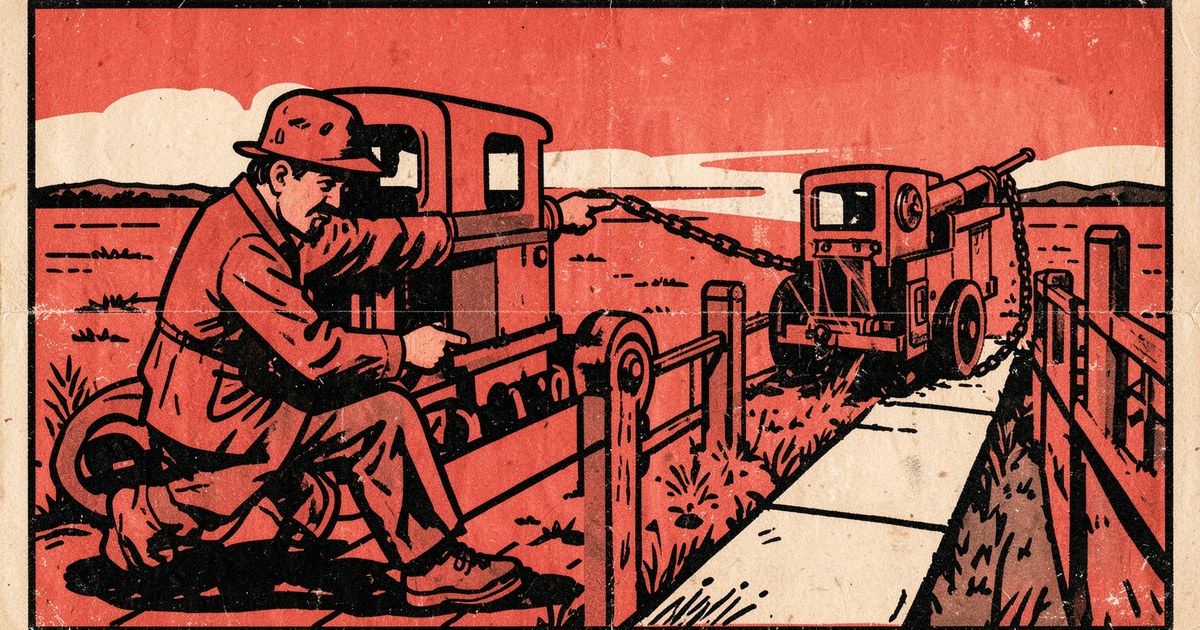
Prompt engineering is a harmful absurdity. The industry has spent so long convincing us that working with neural networks requires special "incantations" that we started mistaking this crutch for a genuine requirement. We got used to treating AI as a dutiful but dim junior developer who needs every single thing spelled out, or they will inevitably wander off course. From this assumption, those multi-story monsters are born: "Imagine you are a brilliant marketer with twenty years of experience, write a text in three paragraphs, use these words, do not use those, breathe every other second."
The truth is that on modern, top-tier LLMs, writing a giant, rigidly algorithmic prompt risks trapping the model inside the walls of your own limited intellect.
The Leash You Mistake for Mastery
Watch what happens when you meticulously script every step of a task. You force the neural network into a narrow corridor of your personal cognitive biases and habitual patterns. You forcibly cut it off from a vast array of possibilities and more optimal, unconventional solutions — approaches you might not even suspect exist, precisely because of your experience or your current tunnel vision.
The model will faithfully and silently execute your instructions. It will ignore the fact that the task could have been solved three times more efficiently through a completely different path that is not obvious to you. On output, you do not get a powerful analytical intelligence. You get an obedient calculator that dutifully invents a bicycle with square wheels, simply because you ordered it that way in your "perfect" prompt.
Here is the trick: the longer and smarter your leash of commands, the shorter the chain of thought you allow a model that has digested the entire internet. You pay for an instrument that outclasses you in iterating through possibilities, and your very first move is to forbid it from being better than you.
"So just throw a couple of words and wait for a miracle?" — No
At this point, any reasonable person steps into the opposite trap: if micromanaging is harmful, we should just toss the model a few vague words and wait for magic. Absolutely not. That is the most critical mistake you can make.
Separate context from the method of solution. These are two different entities, and the entire confusion of the industry stems from dumping them into one pile under the word "prompt."
Context must remain exhaustive, rich, and strictly non-contradictory. The model needs to know everything about your current situation. Designing an architecture? Give it the business requirements, the structure of existing databases, hardware constraints, and the expected load. Solving a product problem? Dump the audience analytics, customer pain points, and budgets. Everything that describes the reality in which the model must operate goes on the table, completely.
But how exactly to use this data to achieve the goal — leave that to the model.
Precision of Reality Instead of Length of Leash
Stop dictating intermediate steps. Present the specific problem to the neural network, load it with perfect factual data without informational noise, and give it room to maneuver.
Modern models have long outgrown the stage where they needed to be micromanaged. The art of working with them now lies not in assembling a long leash of commands, but in the ability to describe the reality in which the model must operate with extreme precision. Rich context is not about piling on more words. It is about consistency and the absence of noise: every extra paragraph "just in case" is another wall in the corridor you are forcing the model into.
Freedom of method is not anarchy. You hand the model the route, but you do not hand over acceptance. What counts as a finished result, what criteria it passes or fails by — that stays with you, and that is also part of accurately describing reality. The freedom is in how to get there, not in where to go or what counts as success. Anyone who confuses freedom of method with the absence of output verification is simply trading one way to screw up for another.
Stop Trying to Be Smarter Than the Tool That Digested the Entire Internet
To boil it down: for years you have been honing a skill that makes you weaker. Every "imagine you are an expert with twenty years of experience" is an admission that you do not trust the model to think wider than you, and simultaneously a guarantee that it never will.
Stop trying to be smarter than the tool that has digested the entire internet — just give it the right data. Describe reality honestly and without noise, state the problem, define what you consider a result, and get out of the way. Everything else you append to a prompt, you append against yourself.