"A non-specialist simply doesn't see the mistakes!" they shout at me in chorus. "We, the real specialists, we see the mistakes. So only we should be solving problems — not some humanities graduate with AI in his hands."
Programmers say: the customer doesn't see the mistakes in the code.
Designers say: the customer doesn't see the mistakes in the design.
Copywriters say: the customer doesn't see the mistakes in the text.
"Would you just leave me alone," says the customer. "I just need it to more or less work and solve my problem."
Stop right here. Because in that chorus of "we see, you don't," what you hear isn't about quality. What you hear is something much older.
The Teacher Walks Between the Rows
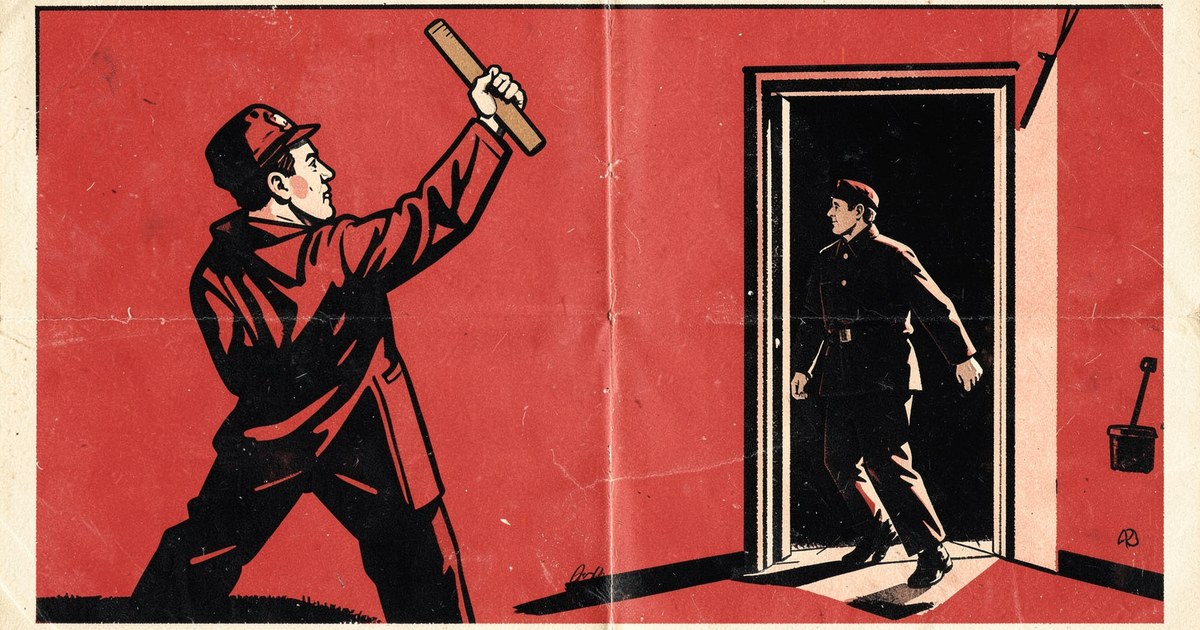
A familiar post-Soviet school reflex is the eternal figure of the teacher who walks between the rows of desks and raps your knuckles with a ruler because you indented your paragraph with the "wrong" number of notebook squares.
Many people carry that school habit into work: find errors first, ask about the task later. Point out the mistakes. Rub his nose in them. Don't miss a single one. Sit there, sweat over your homework so there's nothing to find fault with, or I'll make you rewrite it. You may not publish the result until you've cleaned it of every mistake.
Some specialists bring that same inspection habit into client work and treat feedback as correction rather than help. We know better what the result should look like. Us, us. Not you.
Often this says less about the client’s goal than about the specialist’s need to be right. About how they once got rapped with the ruler — and how they finally get to hold it themselves.
The Customer Asks for One Thing
And the customer asks for one thing — step away. I don't need your control, your mentoring tone, your authority, your years of accumulated taste, and your ruler with which you measure the entire surrounding world against your own templates.
He needs someone who asks what result is enough for the task without perfectionism that delays the result. Without the perpetually condescending tone and the dreary lectures about the ideal result.
The difference shows up in the outcome, because they cost different things. Care moves the task forward; control adds rounds of correction that may not matter to the goal, and the sense that he's been caught again, like in sixth grade, making an "incorrect indent" — only now he's paying for the privilege.
The Ideal Result Is a Pretext
Because when you lecture about the ideal result, the help can turn into a performance of expertise. Clients usually notice it — whether you're a copywriter, a designer, or a developer.
At that point, it no longer looks like help. It looks like jabbing a finger at the beginner, asserting yourself at the "junior's" expense, and preventing him from achieving something on his own, without you. And it pushes clients away. In those moments you're not an expert; you are using status instead of solving the task.
A useful check is this: Care about quality usually starts with the question "do you actually need this for your problem?" Control rarely asks that question — it doesn't care whether things get better, it cares whether things conform to its template. Help is measured by the client’s goal; control is measured by conformity to the specialist’s standard.
In a Normal World, No One Rap Your Knuckles
And yet the customer's whole environment is full of people just like him. People try unfamiliar tools, make imperfect attempts, learn what works, and continue. That is how many practical skills are actually learned.
It would never occur to any entrepreneur to grind a "colleague" down because his product's code doesn't follow the right patterns. Over there, a mistake is part of movement, not a verdict that sends you back to rewrite your homework. In adult work, correction is useful only when it serves the task. The ruler lives only where someone still hasn't gotten out from behind that school desk.
And against that backdrop, AI becomes attractive because it responds without social pressure — not like a supervisor standing at the blackboard.
It Just Doesn't Sit You Down at a Desk
This is what many specialists miss: the customer doesn't choose AI because it's smarter than the specialist. Often it isn't. The customer chooses it because it doesn't try to sit him down at a desk.
AI doesn't wince. It does not shame the user for an imprecise request. It doesn't lecture you about how you should have done it. It doesn't measure you with a ruler or rap your knuckles for the wrong number of squares. It gives a usable first version without arguing about status. Exactly what the customer had been asking live humans for, and getting a mentoring tone in return.
Part of what passed for expertise was really gatekeeping. And the moment the customer had an alternative that doesn't demand that right — many clients started using it instead.
Where to Swing the Ruler Now
From here, the practical conclusion for specialists is simple.
Specialists can keep policing each other’s standards; the customer doesn't care. He no longer has to sit at your desk to get a result. He can now get a draft, prototype, or answer elsewhere.
And those who want to stay relevant need to separate professional standards from the urge to control: put the ruler down. Stop confusing help with supervision, and quality with the right to humiliate. Ask not "where are the mistakes" but "what do you need for this to work and solve your problem." Ask what outcome the client needs, what constraints matter, and where precision is actually worth paying for — because a specialist who only criticizes is easier to replace with a tool that produces a usable first pass.
Many clients were asking for one thing: step away from me with your ruler and just solve the problem. You used to be able to ignore that — he had nowhere else to go. Now there is an alternative, so the old tone costs specialists real work.