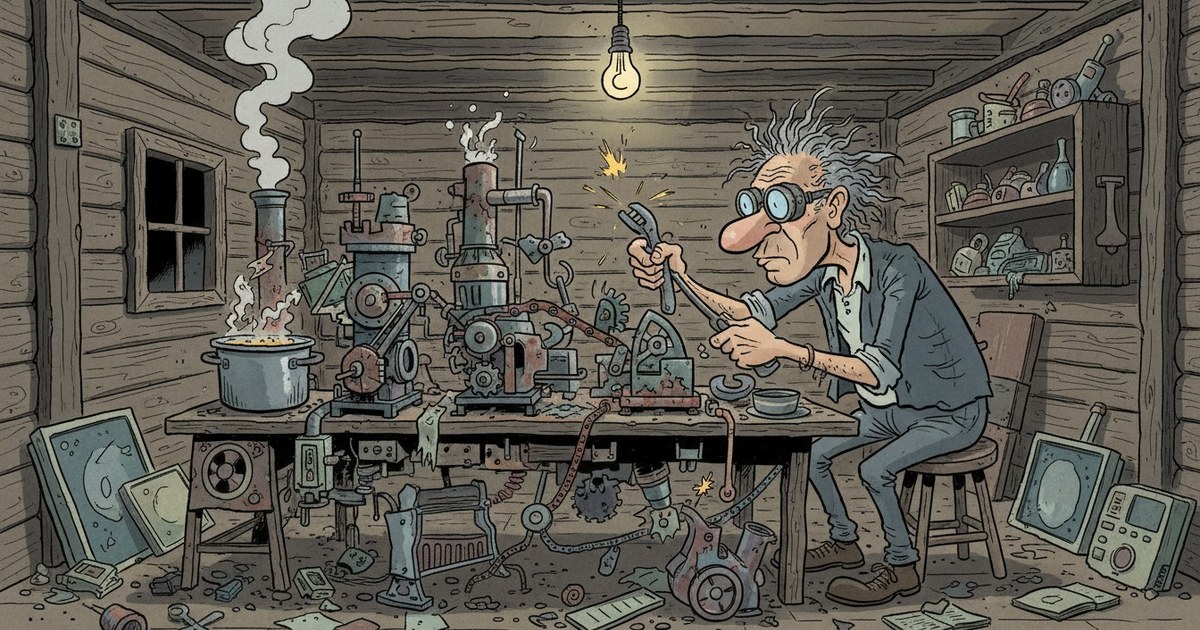
How ready are you for the AI apocalypse? The scenario where the world gets genuinely, thoroughly bad.
I sat down, wrote out what I can actually do. The result was not a shopping list for a bunker — it was a list of skills. And that, I think, matters more than canned food.
Five Years Without an Outlet, a Faucet, or a Radiator
Off-grid living means no electricity, no water supply, no central heating, no gas. All at once. I have spent more than five years total in that mode.
This is not a weekend cabin trip. This is winter mornings where you personally answer for whether the house has light, heat, and water — or doesn't. Apocalypse is not a hypothesis for me. It is a familiar domestic routine.
Light, as Long as There Is Sun or Fuel
Electricity is available as long as there is sun or fuel — including around the clock. I can assemble such a system with my bare hands anywhere in the world the apocalypse drops me, given the source components on hand.
Not "I'm familiar with the topic." Not "I've read about solar panels." I will build it by hand. The difference is roughly the same as between "I've seen a bridge blueprint" and "the bridge is standing."
Heat: 2–3 Liters per Day
Diesel heating, consumption roughly 2–3 liters per day for a family. Holds down to severe frost. Though, of course, it is desirable that the apocalypse catches you in a warm climate — then a jerrycan lasts a month.
The number is not for show. 2–3 liters a day is the exact calculation by which you understand how many weeks your stockpile will last. Survival is arithmetic, not heroism.
Water from Springs — and Then You Improvise
We are used to taking water from mountain springs. We have purification equipment and the skills to use it.
Here is the honest part: when the filters expire past their shelf life, I will have to rig something. There is no ready-made solution for that case — it will be improvisation from whatever is at hand. That is what all of off-grid consists of.
Gas, as Long as There Is Somewhere to Get It
Portable gas stove and 5-liter cylinders. As long as there is a way to scavenge or buy gas and diesel somewhere — you can survive.
The entire structure rests on one assumption: fuel is still available from somewhere. The moment that runs out, the next level of the game begins, and that is a separate conversation.
How to Earn a Living When Money Runs Out
Through services, bartered or paid in fuel. I can genuinely do essentially all domestic renovation from scratch: finishing, utilities, wiring, plumbing.
I grant that during the apocalypse, my skills at cutting and laying 40×40 Italian porcelain tile are unlikely to be in high demand. But here is the core that will not go away: from whatever materials are at hand, in any shack, I will make water, heat, and light.
Give me a broken-down shack with no light, no water, no heat — and I will build a working system out of it. From what is lying around. That is my core instinct — whether in a shack or in any other broken thing that is supposed to work and doesn't.
Food and Medicine: Honestly, Not Everything Is Covered
Food. I have basic skills at growing subsistence crops like potatoes. But herding sheep — I probably cannot manage that. I will ask someone for help.
Medicine. My folk medicine is limited to knowing that plantain is not actually applied flat-side-down on a wound — you use the juice from crushed pulp. Not a lot. I will have to raid medical supply depots.
This is the part of the list where I honestly see holes. A system is built from what you can do yourself, plus what you cover with other people's hands and supply runs. One person does not hold everything — they hold the backbone and know where to source the rest.
What About You, Colleagues?
Apocalypse readiness is not a bunker with canned stew. It is the ability to assemble working water, heat, and light from scavenged materials at any moment, anywhere in the world. A piece of paper with a list of skills will outlast any canned-food stockpile.
What have you got, colleagues? What level is your preparation at?