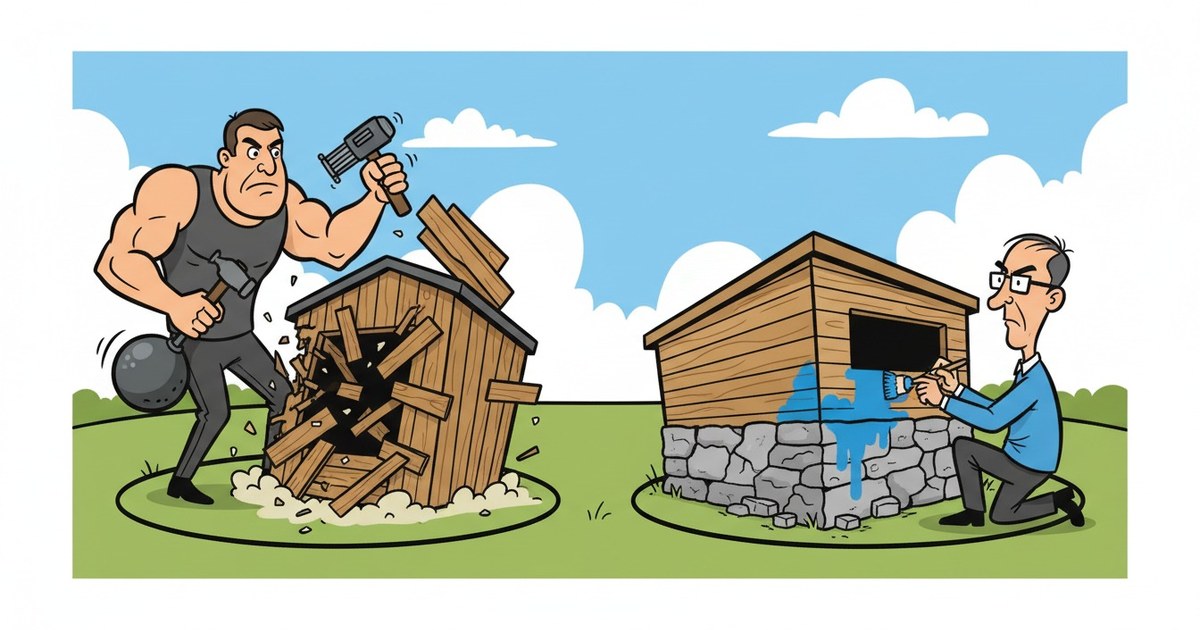
You can vibe-code a toy project in an evening. Nobody argues with that. Then comes the line — "but if you need commercial software that will run reliably for years…" — and on that ellipsis the whole performance begins.
Under one sauce or another, you're being sold the same thing: hire expensive live developers again. So they think through architecture, load, fault tolerance, and all of that. So they lay a foundation. So the product doesn't fall apart in a year.
It sounds solid. Grown-up. Responsible. And it misses the point entirely — because the whole solid thesis rests on one unstated assumption that is already wrong.
The era is over, and you're still blowing up trains
Nobody is going to build software "for years" anymore. Just — nobody. That era is gone and forgotten, and you're clinging to it like a partisan who keeps derailing trains twenty years after the war ended.
The war is over. There's no front. But he keeps mining the rails, because it used to make sense, and giving up the meaning is scarier than admitting there is none.
This entire genre of incantations — "lay the foundation," "think through the lifecycle," "ensure maintainability for years" — was honest craft exactly as long as rewriting a system was expensive. As long as every line of code was an investment you had to protect. Remove that premise, and the whole edifice of the argument hangs in the air.
What actually changed under your feet
The premise is already removed. Right now, for a couple of days and twenty bucks, you can assemble an analog of practically any standard corporate software. Not a "just to look at" prototype — a working analog.
This doesn't change the speed of development. It changes the economics of ownership, which means it changes the entire meaning of the word "maintenance."
And here is where the question surfaces — the one the "thoughtful vibe-coding" crowd has no answer for. If an analog takes two days and twenty dollars to assemble, why would you keep using it for YEARS? Why? What kind of lunatic would do that? To what end?
"Thoughtful vibe-coding" logic, taken to its conclusion
Let's walk through their thesis step by step, slowly, so you can see exactly where it breaks.
Step one: they claim that vibe-coding must be done by professionals who understand architecture, infrastructure, and the rest. Otherwise, in a year, the vibe-coded product will inevitably break and fall.
Step two: therefore, they propose you don't vibe-code for 2 days, but for 3 days. Spend an extra day on the foundation.
Step three: so that you can then use the product for 10 years.
Why? Have you lost your minds?
You're laying a ten-year foundation under a building that is cheaper to demolish and rebuild than to paint. You're insuring for years ahead a thing whose useful life runs out at the exact moment you want to change it. And you'll want to change it soon.
Rewriting is faster than fixing
Because rewriting is no longer a catastrophe. It's a routine operation. Need a different core? A different decomposition into microservices? Fine.
You keep the same data structures, the same UI, the same external API contracts — everything that users and adjacent systems hook into. And you rewrite the core and internal decomposition from scratch. Tell the agent about it and go to sleep. By morning, it's done.
That's the entire "maintenance burden." That's the entire "product lifecycle for years ahead."
Here's what this means for their argument. "Maintenance" in the old world was the long, expensive survival of a chunk of code that was too costly to throw away. When throwing away and rebuilding costs one night and one prompt, the very concept of "maintaining for years" loses its object. There's nothing to maintain: what breaks doesn't get fixed over a week — it gets rebuilt overnight.
"Hard to maintain" — in a world where nobody is going to maintain anything
Now go back to their incantations and listen. Oh, we need to lay architecture and a foundation. Oh, it'll be hard to maintain. Oh, it'll be difficult to extend.
Do you understand how insane this sounds — in a world where nobody is going to maintain or extend anything at all? Hello?
This isn't a response to the new reality. It's a script from the old one, still being read out by inertia, because the entire professional self-esteem and the entire price tag depended on it. The argument about the difficulty of extension carries weight exactly where extension is cheaper than replacement. And it isn't anymore.
No answer
Ask directly — "why lay a ten-year foundation under something that rewrites overnight?" — and silence. They repeat from the script: oh, you need to lay architecture, oh, it's hard to maintain, oh, it's difficult to extend.
Ask "why" — no answer.
Not because the answer is complex and they're too lazy to formulate it. Because there isn't one. A foundation "for years" was an answer to a question nobody asks anymore. The era where software was built to stand for decades is over — and the only thing the "thoughtful vibe-coding" crowd has left from it is the habit of mining rails on a front that no longer exists.