"AI should augment humans, not replace them!" — hundreds of people write this to me. Not a single one of them is in a leadership position.
Beyond the obvious infantilism of the thesis — it reads like a whimpering "please don't replace me" — let us seriously examine the economics. Not the emotion, not the morality, but the arithmetic by which hiring and layoff decisions are actually made.
The main question everyone skips: what made you assume anyone wants to augment you in the first place?
Business never had the goal of improving employees
Clients and executives never had the objective of "making employees better." That is a pleasant formulation for conference panels, not something anyone pays for. Business has always sought to reduce its dependence on the human factor. Not because someone is malicious, but because a human on the payroll is expensive and unpredictable.
Break down what that cost actually is. A person on staff is not just expertise. They are a bundle of unavoidable expenses and risks — visible in the accounting, not in a motivational post.
Direct costs: salary, taxes, insurance contributions, sick leave, vacation pay, and workspace setup.
Administrative risks: burnout, emotional slumps, team conflicts, and sudden departures to competitors mid-project.
Human frailty: people get tired, lose attention, hold biases, and fall prey to cognitive distortions.
Scaling problems: hiring and onboarding a new specialist takes months and consumes HR resources plus senior engineers pulled away from their own work.
Add all of this into a single line and you get not a "valuable team member" but an asset with a high total cost of ownership and a hard-to-predict return. Every business dreams of absolute predictability. AI delivers exactly that: it works 24/7, does not ask for a raise, does not go on parental leave, and does not fall into depression. That is the backdrop against which the "augmentation" slogan should be read.
What actually happens when a tool "just helps"
Even when a tool is honestly positioned as an assistant, it inevitably leads to headcount optimization. This is not a vendor conspiracy — it is a direct consequence of the link between productivity and headcount.
Suppose a company adopts a neural network that doubles the productivity of a programmer or a copywriter. For management, this is simple arithmetic.
Before: 10 employees produce 100% of the work.
After: 5 employees with AI produce the same 100%.
The result — the remaining 5 people are shown the door. "Augmenting" one employee automatically and inevitably makes another redundant. The tool you ask to augment you, in the same formula, eliminates your open-space neighbor — and at the next productivity cycle, you.
This is not a novelty of the technology age. It is an old mechanism with a name.
The digital assembly line: what Ford did, now with expertise
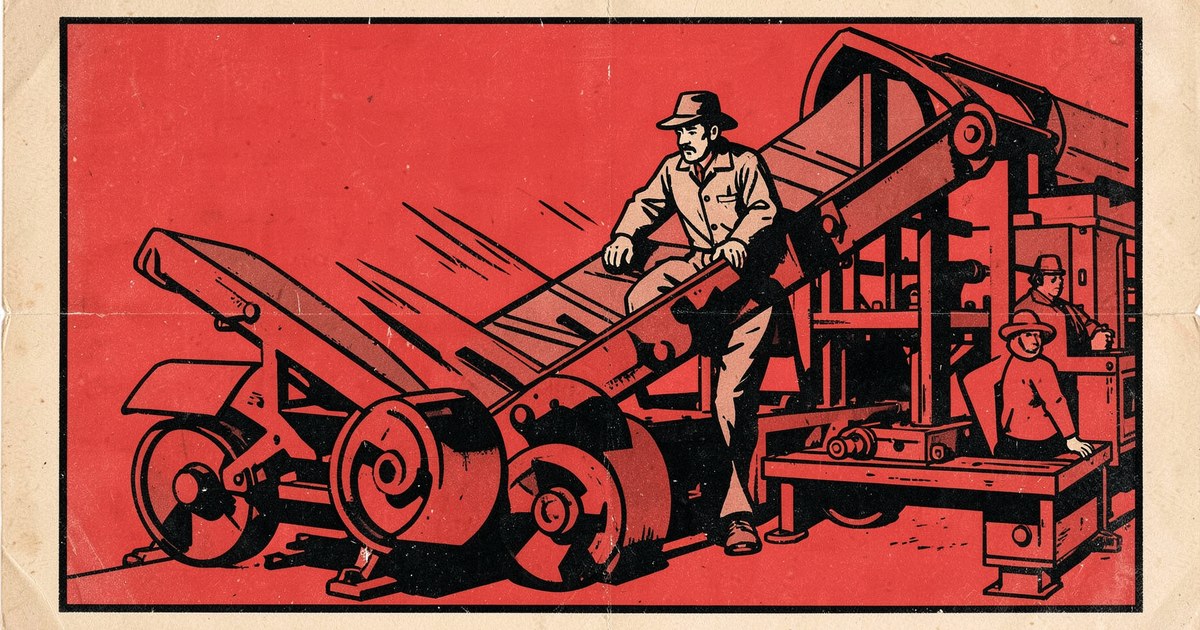
Henry Ford's assembly line was not introduced to "augment" craftsmen and refine their art. It was created to transform complex master labor into a sequence of simple operations that any untrained worker could perform for less money. The master was expensive and irreplaceable; after the assembly line, he was no longer needed.
AI is the digital assembly line of the 21st century. Its task is to standardize processes, alienate knowledge from the specific performer, and turn expensive expertise into cheap infrastructure. What used to live in the head of an expensive specialist and leave with them is now decomposed into operations and deposited in the system. Expertise stops being your personal rent and becomes shared infrastructure — as available as electricity from a socket.
This is where the main misreading of the exoskeleton slogan originates.
The survivor is not the one who got augmented, but the one who removed themselves from the process
The dream that AI will become a permanent "exoskeleton" that simply lightens the workday without changing the rules is an illusion. The market selects efficient solutions without sentimentality. If a technology allows a company to close a position with an algorithm or cut a department by two-thirds, the business will do it. Not because you are not valued, but because you are valued at exactly the cost of your unpredictability.
Here is where the real line is drawn. The survivors will not be those who ask not to be replaced, but those who know how to manage these algorithms, take responsibility for the final business result, and REMOVE themselves from the process.
The distinction is straightforward. As long as a person's value lies in personally performing an operation, they are exactly where the assembly line aims: inside the process, in the seat being standardized and cheapened. Value shifts one level up: to design the contour in which agents operate, to answer for the outcome of that contour to the business, and to not be a component of it. The cheaper algorithmic labor becomes, the more expensive the person who designs the system and holds responsibility for its outcome — not the person competing with the algorithm for the same operation.
Removing yourself from the process is, perhaps, the most in-demand skill of 2026. And here is the most uncomfortable conclusion for those asking not to be replaced: as long as you are inside the process, you are demonstrating a dreary, extreme unprofessionalism. You are manually performing what has already become infrastructure and presenting it as value.
Who told you anyone wants to augment you
Bring it all to one point. "AI should augment, not replace" is not a description of the market — it is a plea to a market that has never had that motive. Business does not improve employees; it reduces its dependence on them. Augmenting one makes another redundant. The assembly line alienates knowledge from the performer — that was true under Ford, and the digital assembly line works the same way.
The question is not whether you will be replaced or augmented. The question is whether you are inside the process or above it. Whoever is inside is in the queue for optimization, and no slogan will pull them out of it. Whoever manages the algorithms and owns the result stops being a line item and becomes the reason the whole thing was built.
If you are still inside the process, manually executing what has already become infrastructure and calling it a contribution — you are not being threatened by AI. You are demonstrating that you never understood what business pays for.