The most successful "flat" organizations I've encountered weren't actually flat. Someone was making decisions. Someone was absorbing pressure. Someone was the de facto leader — without the title, without the accountability, and without the legitimate authority that would have made the whole thing transparent and fair.
That's the paradox that corporate culture refuses to name honestly. Decades of management philosophy have convinced us that hierarchy is a relic — a symbol of authoritarian control to be dismantled in the name of equality. In practice, every group under pressure instinctively organizes around someone who will decide, who will be responsible, who will take the hit.
This isn't conformism. It's mechanics.
Why Humans Seek Strong Leaders
The human brain is expensive to run and deeply intolerant of uncertainty. Uncertainty produces anxiety; sustained chaos puts the system in permanent overdrive.
Research in social psychology confirms this. Aaron Kay's compensatory control theory — the mechanism by which loss of personal control drives people to seek order elsewhere — and Larissa Tiedens' research on dominance complementarity and hierarchy preferences both point to the same finding: when people lose personal control, their demand for external structure increases sharply. The brain isn't looking for someone to submit to. It's looking for something to reduce cognitive load.
In a horizontal partnership, every problem becomes a negotiation. Every participant continuously calculates: where does my authority end, who decides this, who takes the blame if it fails. That calculation runs in the background, consuming processing power that could be going toward the actual work.
A clear hierarchy provides immediate reference coordinates. It removes the weight of global responsibility from the individual. It allows people to focus on their domain — knowing that problems outside it will escalate upward, not turn into an open-ended collective project with no resolution path.
What Teams Are Actually Buying From a Strong Leader
A strong leader who builds hierarchy makes a foundational promise: if a problem exceeds your competence and authority, it stops being your catastrophic failure. It becomes my problem.
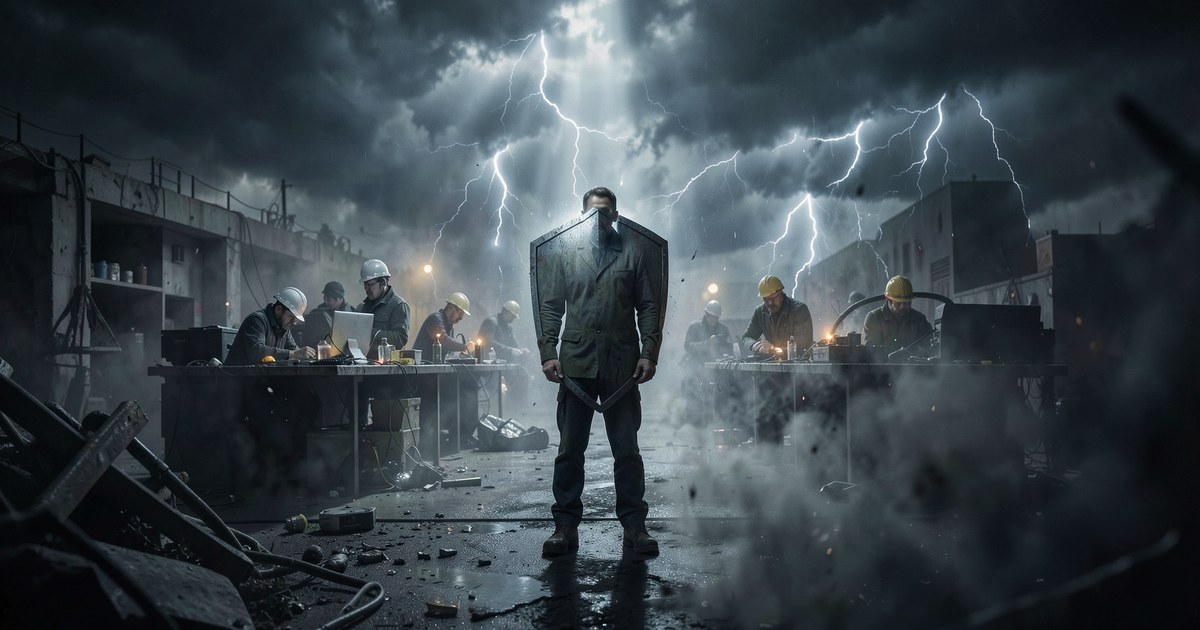
The leader functions as a shield — absorbing external pressure and extinguishing threats before they reach the layers where the actual work happens. The business is panicking about timelines, a client is demanding answers, investors want explanations — all of that stays above, without punching holes through the engineering or product team doing the building.
This is psychological safety in its mechanical sense. Not a corporate slogan, but a structural guarantee: the person knows someone is holding the external perimeter.
I've managed more than twenty distributed engineering teams across different organizations. The pattern is consistent. A team that can see external chaos being absorbed above can work with depth and focus. A team thrown directly into external noise spends its energy on defense, and eventually burns out.
Entering a hierarchy is not a sign of weakness or submissiveness. It's a rational exchange — a portion of individual sovereignty for order, predictability, and the right to do your job without constantly managing the entire universe.
Three Fears That Stop Leaders From Building Hierarchy
If this is all true — why do so many managers actively avoid creating clear structure? They have the title, the authority, the budget. But they play at democracy, call the team a "family," insist everyone is an equal partner.
Management psychology calls this the authority avoidance syndrome, or the friendly-manager trap.
Fear of rejection. Setting limits, evaluating performance, and making unpopular decisions require managerial will. A leader driven by an excessive need for approval fears losing colleagues' affection. They believe that building hierarchy means becoming the harsh boss everyone resents. So they sacrifice the stability of the system for the illusion of universal approval.
Fear of sole accountability. Standing at the top of the hierarchy means declaring yourself the final escalation point. In a diffuse pseudo-horizontal structure, there's always a collective to hide behind — the team didn't reach consensus, the project was shared. In a clear hierarchy, that option disappears. When the system fails to resolve something at the lower level, it's the leader's personal failure.
Impostor syndrome plus cultural myth. The deep-rooted belief that hierarchy equals outdated authoritarian evil, and that progress means total equality. In trying to avoid micromanagement and domineering behavior, weak leaders throw out the accountability structure along with it.
When There's No Hierarchy: What Actually Happens
The manager who avoids building hierarchy out of ostensibly good intentions does real damage to their team. By refusing the formal leader role, they don't free people. They leave them defenseless.
Sociologist Jo Freeman made this case in her essay on the tyranny of structurelessness: structureless groups do not exist in nature. When formal structure is destroyed — the transparent rules, the clear escalation paths, the identified leaders — informal hierarchy fills the vacuum immediately and inevitably.
Informal hierarchy is the worst kind of social arrangement. It runs on personal charisma, backroom politics, and favoritism, with no explicit rules and no one to hold accountable. Strong performers burn out quickly, spending most of their energy not on building the product but on navigating horizontal disputes and pushing through walls that shouldn't be there.
"Flat structure" with diffuse accountability doesn't eliminate politics. It makes politics the primary survival tool.
Hierarchy Is a Contract
Hierarchy is a social contract. Not an instrument of oppression — a mechanism for survival.
Real leadership means carrying the weight of sovereignty: organizing order from chaos, giving the people who follow you a world with clear rules.
Leaders who find the courage to accept that role — who stop being afraid of their status and authority — give their people something real: the ability to do their best work, knowing there's a reliable system behind them.
Leaders who continue hiding behind democratic theater give their people something else: informal hierarchy, politics, and burnout.
The choice between these two isn't philosophical. It's operational.
If you're building or fixing the structure of an engineering organization — you know where to find me.