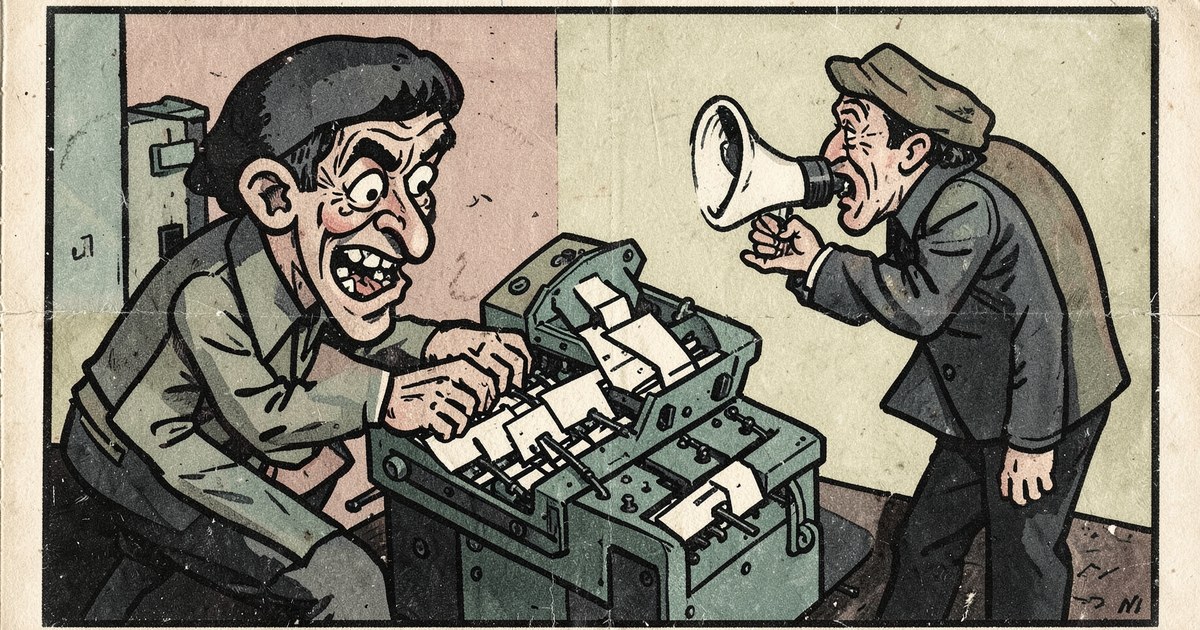
Every time an evangelist takes the stage and cheerfully suggests offloading routine to neural networks, the IT community has a collective skeptical meltdown. The sighs, the sarcastic comments, the long threads about how speakers are detached from reality: "AI can't think," "it hallucinates," "who's going to rewrite this code?"
The complaints look strange for one reason. "Just give it to AI" is a metaphor compressed to fit a short clip. Nobody on stage means "press a button, go get coffee, and the algorithm builds you a spaceport." The literal reading belongs entirely to the listener — they invented it, got outraged by it, and won the argument against it.
The cost of arguing with your own hallucination
The real cost appears elsewhere. While the thread is busy debunking a thesis nobody proposed, the actual work doesn't go away.
The arguer isn't building a task specification. They aren't marking the boundaries of what the agent is allowed to touch. They aren't setting up acceptance criteria. Six months later they still don't have a single process where an agent carries part of the load under control, but they do have a collection of arguments for why it's impossible. They pay for the argument with time the competition spent restructuring.
There's a separate tax — fear. For a CTO, "the agent did the wrong thing" is scarier than "the agent is slower than a human." The fear is justified, but the cure isn't refusal — it's a control loop: observability, boundaries, acceptance gates. Refusal preserves the fear; it doesn't remove it.
What the phrase means in a professional conversation
In a professional context, "give it to AI" means exactly one thing:
Restructure your organizational and technical processes so that you can delegate this work to an agent — with task specification, oversight, and acceptance of results.
Delegation only works if the task is specified, execution is supervised, and the result is accepted against explicit criteria. If any of these controls is missing, the process becomes unsafe or unverifiable. Remove any single one and you get exactly the caricature the skeptics are so convincingly arguing against.
You don't hand the contractor the passwords, do you?
This phrase has an exact managerial twin that everyone uses without thinking.
When a director says "delegate this to the contractor," nobody assumes you drop the root passwords to the infrastructure and leave for vacation. Everyone understands what follows: write a clear spec, mark the boundaries of responsibility, set up a review pipeline, validate the final result. Nobody is bothered by the fact that the contractor might do the wrong thing — that's what the spec and acceptance are for.
With AI it works exactly the same way. The model still needs the same controls as any external executor. It adds an automation layer that requires managers to define verifiable tasks and engineers to build control loops around execution.
What it looks like when built by hand
The difference is in the workflow.
Specification gate — a specification you can verify. A task doesn't enter the workflow until it has a goal, a defined scope, and checkable acceptance criteria. I built a separate gate for this in Jira: the ticket doesn't move forward while the formulation stays vague. In this workflow, failures more often come from vague requirements than from model output. It's the specification where half the requirements lived in the author's head. Open source: github.com/dobryakov/jira-clarify-bot.
Approval gate — a human in the loop on approve. The gate isn't an automatic rubber stamp: a person makes the decision. And right here the main failure mode of this scheme surfaces — approval without falsifiable criteria. You click "approved," the criteria remain slogans like "should work correctly." The gate is formally passed, the spec is still vague, and the agent gets the blame.
Role separation — separating specification from execution. The specifier writes a file in inputs/. The executor sees one file and performs one operation. They don't know context beyond the task, don't wander into adjacent systems, don't fill in the blanks.
Triage — deterministic triage. This is exactly why the separation exists. No file in inputs/ — the specifier broke. No result in outputs/ — the executor broke. Both present — open them and compare "what was asked" with "what was delivered." The audit runs through git log: who, when, what they put in and what they took out.
This is the "just give it to AI" that fits into a short clip as one phrase, and in reality takes four steps and several weeks of restructuring.
Operational limitations
The scheme isn't free. It is better to describe the costs explicitly: latency, boundary erosion, and false security.
Latency grows. The gate on specification and the human on approve add time to every cycle — where a ticket used to fly into development in a minute.
There's a social risk. There's a constant temptation to give the executor a bit more context "so they understand better." Every such step erodes the boundary and kills the determinism of the triage: the moment the executor sees something extra, the question "who broke" stops having a single answer.
This doesn't replace PAM. Separating specification from execution gives you observability and a boundary of responsibility, not privileged access management. Anyone who confuses the two gets a false sense of security.
Separately: the gate on specification doesn't make requirements good. It makes vague requirements visible. After that, everything depends on the person clicking approve.
Why most people get nothing out of it
The common failure mode is organizational. In many failed deployments, the model is not the only or main bottleneck; task design and acceptance criteria matter as much.
Engineers know how to build pipelines, but not how to specify a task so the result can be accepted against criteria. Managers know how to set tasks and accept work, but not how to build the loop in which a machine executes it. Delegating to an agent requires both competencies simultaneously — an engineering approach to management and a managerial approach to engineering.
Many teams lack at least one of these competencies. This partly explains the hostile reaction: nothing works with AI, so the problem must be AI. A literal reading of the metaphor can avoid the harder discussion about process design.
What to do if you read this far
The practical change is to start with one controlled workflow.
Pick one process. Put a gate in front of it: goal, scope, falsifiable acceptance criteria. Split specification and execution into separate roles and separate directories. Keep a human on approve and track not how many tickets passed, but how many passed with criteria that can actually fail. Triage incidents by three states — no input, no output, both present.
Observability comes out of the filesystem and git, without a separate platform for agent management. What comes after — access, audit, integration with what you already run — is a question of someone else's infrastructure boundary.
Restructuring beats debating the slogan
"Give it to AI" isn't an instruction to press a button. It's a demand to restructure processes for delegation: specification, oversight, acceptance. Exactly what you do with a contractor — just a different executor.
If the phrase is read literally, the discussion misses the actual issue: how to build controlled delegation. Teams that define specs, controls, and acceptance gates will gain experience faster than teams that only debate the wording.