You're afraid to use AI for real.
You write code with it, you build products with it, but in your mindset you're still a Siberian lumberjack who just got handed a Japanese chainsaw. You took a tool from another era and you're sawing the exact same log with the exact same motion you used with an axe. Different tool, same head.
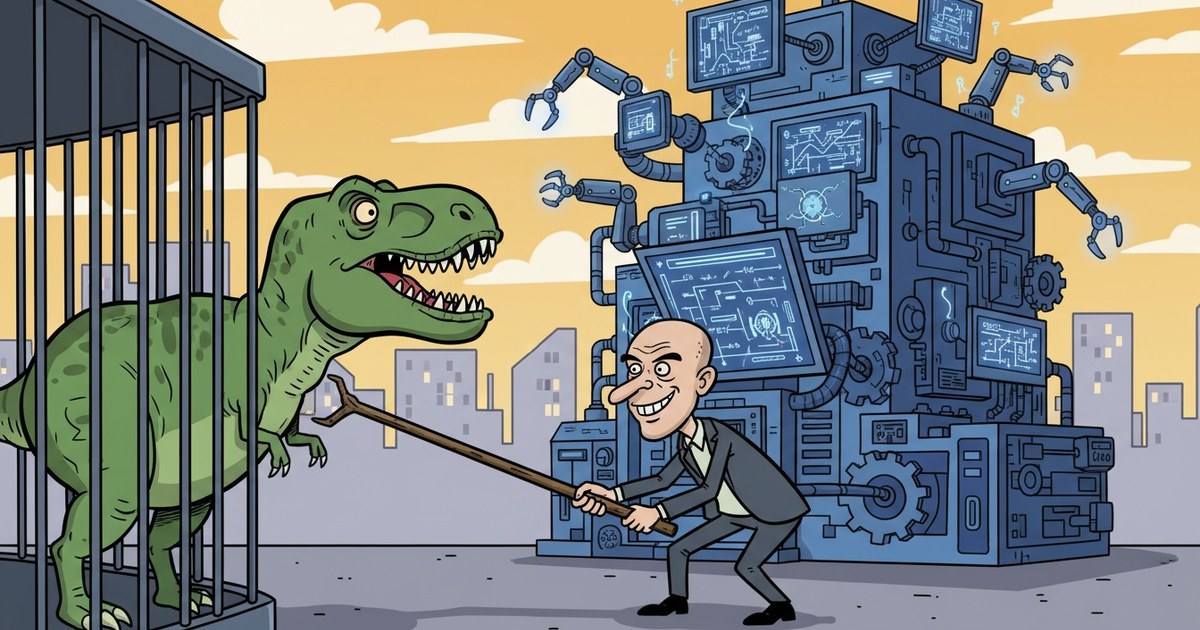
You're poking a dinosaur through the bars at the zoo, staying at a safe distance. Wow, it can do that too — who would've thought. You look, you marvel, you walk away to argue about what percentage of your codebase was written by a neural network.
The percentage debate is a conversation for the frightened
This endless, dreary negotiation — should AI write 30, 60, 90 percent of code — is a conversation among people standing on the safe side of the bars with no intention of opening the gate. It's a way to touch the future without entering it. While you measure the percentage, you remain the author of the process: you write, AI helps, you review, you decide. The gate is still there. The beast is still behind it.
The price of that comfort isn't falling behind on trends. The price is this: while you debate the share of autocomplete, someone nearby is changing the nature of who operates the product. By the time that becomes visible on the market, there will be nothing to catch up with. You optimized typing speed; the competition was about something else entirely.
What it means to not be afraid
Here's what AI application looks like for those who aren't afraid.
Imagine a project where nobody writes code by hand, nobody tests, nobody configures servers. Not "AI helps write" — nobody writes. There is no human in the loop.
AI autonomously monitors how real users interact with the product. It understands usage patterns, watches the market and competitors, decides how to improve a situation, selects the product metric to optimize, makes changes, runs A/B tests, evaluates results — ships the feature or rolls it back.
Continuously, around the clock, without human involvement. Full Agentic SDLC.
Thousands of micro-movements, like a trading bot on the exchange
Hundreds and thousands of small experiments. Like high-frequency trading, where a bot makes countless micro-movements of capital, trying to outpace other bots — slower ones, dumber ones.
That's the shift that doesn't fit into the question "what percentage of code." Nobody on the exchange argues about what percentage of trades were made by a human versus an algorithm. There are robots operating in the microsecond range, and there's everyone else, who lost before they could press the button. No gate. Machine speed and machine intelligence against yours.
Transfer that to product development. While a team gets on a call, discusses a hypothesis, argues about Jira priorities, ships a release every two weeks, and checks the dashboard a month later — an autonomous loop has run a thousand hypotheses in that same month. Tested each one on live users, kept the winners, rolled back the rest without drama or retrospectives. Not twice as fast. A different order of magnitude.
This isn't fantasy — pieces of this loop are already running
An honest moment here. A fully closed loop where AI selects the product metric, deploys, and decides the fate of the entire product without a single human — that's a challenge, not a ready-made production case I'm handing you with a receipt. I'm not selling you a complete autonomous product factory as established fact.
But you can't file it under fantasy either, because individual pieces of the loop are already running — hands-on, not on slides.
Autonomous trading loops are already alive. An ML service that progresses through its own lifecycle modes: warm-up, online learning, intelligent — with automatic transitions triggered by quality thresholds. The AI there isn't deployed once and frozen; it manages its own lifecycle in production, deciding when it's ready for the next mode, everything monitored in Grafana. That's the exact micro-movement loop from the exchange analogy, not as pretty words but as a working service.
Autonomous agent organization isn't a slide deck either. Roles: Strategy, Sense, Act, Guard. Fail-closed principle. Guardian veto over agent actions. AI agents replacing humans with minimal owner involvement. This is a direct answer to "who handles it when an agent goes rogue" — an architecture where autonomy has a fuse, not blind faith.
Autonomous testing and rollback — an eval-harness as a release gate: three layers, drift thresholds. Plus a self-healing browser harness that fixes its own broken UI runs. That's the part of the loop where a change either sticks or gets reverted — without a human standing over the deploy button.
And operations — LLM as a consumer of events from Kafka and webhooks, Grafana, automatic root-cause analysis. Not just shipping, but understanding what broke and why.
Put it together. Lifecycle management in production, an agent org structure with a fuse, an autonomous gate and rollback, autonomous incident analysis. That's not the entire product loop, turnkey. But it's every load-bearing node — assembled and tested individually. The question hasn't been "is it possible" for a long time. It's "who assembles the whole thing first."
A pattern, not a pretty accident
And to dispel the sense that this is a conversation about nothing: this direction grows not out of a love for technology, but out of numbers that already happened. Over 199 million profiles actually served by personalization. A defect flow crushed from 5–10 per day to five per week, with revenue growing one and a half times. Those are the traces showing that management based on continuous observation and rapid iteration produces an order-of-magnitude difference — where humans took it all the way. The autonomous loop is the same principle, stripped of the human throughput bottleneck.
A different operating model, not a typewriter upgrade
That's what AI in software development looks like. Not an endless, dreary negotiation about what percentage of code AI should write, but a different operating model.
The difference between the lumberjack with a chainsaw and the one who isn't afraid isn't the tool. The tool is already in your hands — the same one. The difference is who's ready to let go of the log and stop sawing by hand altogether. Who's ready to open the gate and step into the cage instead of poking the beast with a stick from a safe distance.
The gate, by the way, isn't locked anywhere. It's locked in your head.
So — who's brave enough? Let's time how long until this becomes normal.