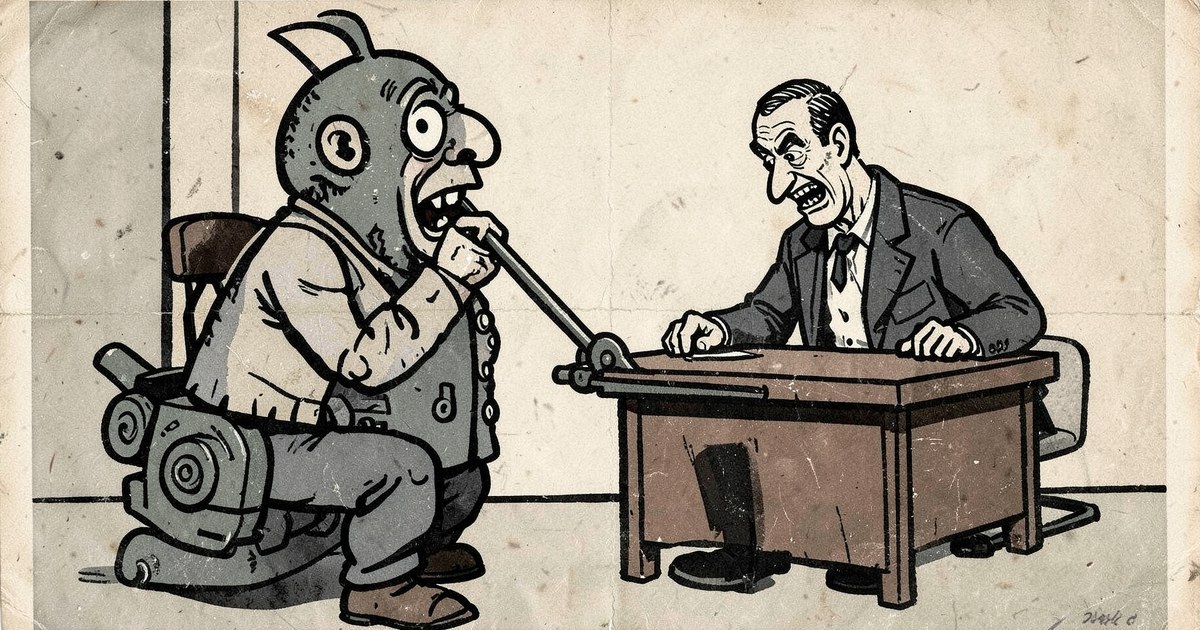
Managers can no longer justify high compensation only by saying their decisions are too complex to formalize.
The first visible effect of generative AI was on execution-heavy work: routine code, drafts, basic design, and copywriting. Top management watched from above — with some sympathy and complete certainty that their own work was beyond a machine's reach. That assumption is starting to fail. The same automation pressure is now reaching people who assign and review that work: AI is beginning to reduce the cost of collecting facts, comparing options, and flagging inconsistencies.
I saw the first wave on my own projects, not in the news. One person with competent AI orchestration handles the volume that used to require an entire department. And when the executor's work gets devalued, the next in line isn't the executor — it's the person sitting one level above, distributing their tasks.
Managerial judgment is becoming partially formalizable
Some parts of managerial decision-making — risk tracking, resource comparison, planning checks — can already be supported or partially automated. Parts of it are computational tasks: comparing estimates, tracking commitments, detecting contradictions, and ranking risks.
The economic effect appears in the coordination layer. An experienced manager gets tired, falls into habits, gets distracted, and hears what is convenient to hear. Companies often treat these habits as part of managerial expertise and price them accordingly. A bloated management layer, where margin leaks into coordination and approvals, rests on a single assumption: human judgment is irreplaceable here, and therefore expensive. If that assumption weakens, part of the director-level coordination layer becomes harder to justify economically.
I Started Embedding AI Into Exactly This Layer
This comes from implementation work, not from a forecast. In a large enterprise organization, I came in effectively as an engineering leader from an architecture seat and saw that the main inefficiency was not in the code. It was in the management loop: in requirements, in task definition, in cross-team alignment. That is where I started embedding AI first, not just in development.
In many companies, AI has reached individual contributors faster than planning, prioritization, and cross-team coordination. Project managers, field leads, account managers look at it as a demo: not integrated into the work loop, not measured. At the bottom, engineers have already restructured their work. At the management level, AI is often still treated as a presentation tool rather than as part of the operating loop.
A project-control system using agents is already running
This is not only a forecast: I am using such a system on live projects now. A system of humans and agents, assembled from several agent workflows, project documents, chat data, and scripts, has been running on live projects for about two months. On two simultaneously.
It maintains a consolidated view of project documents, commitments, estimates, and unresolved questions. It weighs facts by source weight: a phrase dropped in a chat and a signed document mean different things, and the system distinguishes between them. It catches contradictions between documents and unfulfilled promises. It flags discrepancies that are easy to miss during daily coordination:
- Promised to deliver for X, but the estimate says 2X.
- The client has been waiting two weeks for an answer, while internally everyone is sure «everything is under control.»
- Two documents disagree on the numbers — and it is immediately clear who to go talk to.
It does not get tired, does not get distracted, and does not defer to authority. These properties are useful precisely where human review is vulnerable to fatigue, distraction, and hierarchy. And this is not a promise for the future — the system is already catching these errors on real contracts.
Resistance will likely come from the management layer
A similar defensive reaction is likely among managers whose work is exposed to measurement and automation. This time, resistance may come from people whose authority depends on opaque judgment. The likely objections are predictable:
«AI lacks empathy and emotional intelligence.» «An algorithm cannot understand business context the way a human does.» «A machine cannot bear legal and moral responsibility.»
The first two can be valid in some cases, but they are also often used to protect opaque decision-making. Empathy is valuable, but it is often constrained by reporting cycles, budget pressure, and incentives. «Understanding context» in practice often means remembering who owes what to whom. If a system tracks commitments and contradictions more consistently than a human manager, objections about «context» need to be tested against actual performance.
The third argument is more honest. A machine indeed does not bear legal and moral responsibility. But there is a substitution hidden here. Responsibility remains not with the person who shuffled papers and rubber-stamped approvals, but with the person who designed the decision-making loop itself and answers for its outcome. That is a completely different role.
What changes is administrative judgment, not management as a whole
The distinction is this. Algorithmic management does not kill management. It reduces the value of coordination work that consists mainly of routing decisions, reconciling documents, and approving tasks without adding accountability.
As agent-based systems become more reliable, the valuable role shifts toward designing, supervising, and being accountable for the system. Not «doing what agents cannot yet do,» but designing a system of agents and answering for its result to the board. This role is hard to standardize because it depends on company-specific processes, risks, and accountability. And there is an inverse relationship: the cheaper the labor of the agents themselves, the more expensive the person who designs and holds the entire loop.
So the line does not run between human and machine. It runs between the manager who defended the rent for rubber-stamping and the person who designs the decision loop, defines escalation rules, and is accountable for results. The first role will be easier to automate or cut; the second will likely become more valuable. The era of «irreplaceable» managers is closing — but precisely the kind of irreplaceability bought with intuition and title, not with result.
Companies will compare managerial layers by cost, reliability, and outcomes
The direction is likely to be driven mainly by economics. As with software development, initial resistance will be tested against cost, reliability, and measurable output. The owner, the CEO, and the board do not need a coordinator's charisma — they need predictable delivery and lower coordination cost.
For owners, the comparison is straightforward if the management layer can be measured. You can keep paying for «intuition» that cannot be measured, that gets tired, and that hears what is convenient. Or you can measure the management layer and integrate it into a loop where decisions are made stably and verifiably. Companies that measure and redesign management workflows early may gain an advantage similar to early adopters of AI-assisted development.
Algorithmic management is already being used in project control
AI first reduced the cost of some execution-heavy tasks; it is now beginning to reduce the value of some coordination-heavy managerial work. But not the ability to design a system and answer for its result. That ability may become more valuable as execution and coordination tools get cheaper.
The claim of managerial irreplaceability is becoming harder to defend where decision loops can be instrumented and audited. I am not waiting for it as a prediction: I am already building this loop by hand, on live projects. I can show the workflow on live projects: how it tracks commitments, compares documents, and escalates contradictions.