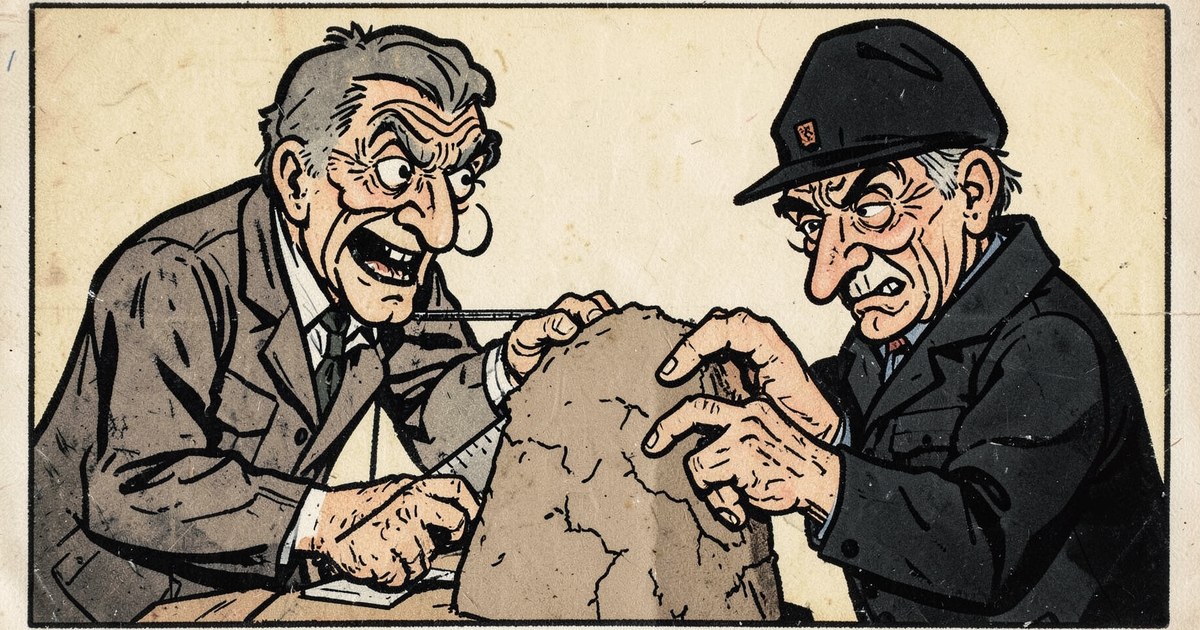
Watch a developer look at a humanities person who just got a text from a neural network and is genuinely happy with it. The look carries a question the engineer will never say out loud: "Why do you let yourself be this imperfect?" The model got two facts wrong, blurred a third, and the person across the table is smiling and taking the result to work. For the engineer, this is not joy — it is professional incompetence that someone is somehow unashamed to display.
The scene is uncomfortable because the developer and the humanities worker judge the output by different standards. One treats the answer as a product to verify; the other treats it as material for further thinking.
The Irritation Has a Price Tag
What drives the engineer crazy is not the inaccuracy itself. It is that someone gets a satisfying product by bypassing everything the engineer considers the profession. You spent years building discipline: reproducibility, minimizing error, controlling every link in the chain. Next to you, a person pulls a draft out of a "hallucinating" model with three sloppy, emotional prompts — and the draft genuinely satisfies them.
From here comes the devaluation that the engineer starts saying out loud: why build high-precision systems at all if the user is ready to be happy with an approximate answer? Every inaccuracy in the model's output is a failure to fix, not a property to live with. Joy over "roughly correct" reads as rewarding defects.
The humanist, in turn, finds the engineering approach excessively dry. They see how trying to force a living process into rigid algorithmic frames kills exactly what they came to the model for: intuition, unexpected association, a lateral move of thought. Where the engineer brings order, the lights go out for the humanist.
At first it may look like a preference for different working styles — everyone has their preferred way of working. The actual disagreement is about the acceptance criteria for the result. These are two different evaluation metrics applied to the same model.
Two Different Metrics, One Model
An engineer usually evaluates a neural network as part of a system. Complex, requiring architectural understanding, prompt optimization, continuous combat with hallucinations. A good result here is predictable and repeatable: the same input gives the same output, error is known and bounded, deviation is caught and fixed. These are reliability requirements, and it is the necessary standard where an error costs money, time, safety, or reputation.
The humanist approaches with a different metric because their material is different. Text, meaning, emotion, and context are often evaluated through interpretation rather than exact measurement. For a philologist, a marketer, a writer, a philosopher, the model is not a calculator or a reference book. It is used as an interlocutor or drafting partner. In that use case, the value is not factual completeness but whether the exchange helps produce a usable idea.
So the humanist easily forgives the model's factual lies. They were not looking for a reference; they were looking for a metaphor, a structure, or a starting point. They accept the probabilistic, unfinished nature of a generative model as a natural extension of human thinking, which itself is rarely perfect on the first draft. In reliability tasks, probabilistic behavior must be constrained; in exploratory writing, it can be used as material.
Where the Argument Turns Out to Be False
A common next step is to frame the dispute as a question of maturity. The engineer is sure maturity means control. The humanist thinks maturity means letting go and trusting. Both framings miss the task distinction, because maturity is not about a pole at all. It is about a question neither of them asked: what is the task and what failure mode matters here?
Once the task is specified, the conflict stops being a culture clash and becomes ordinary discernment. The reproach about imperfection reveals not two temperaments but two irreducible kinds of work.
Engineering work often aims to reduce error in systems where failure has consequences. Its product is reliable, predictable infrastructure you can lean on without thinking about it. Humanities knowledge is occupied with the exact opposite: it explores the space of ambiguity, where deviation from the norm, an unusual glitch, a "wrong" association often become the source of new meaning. One practice reduces error; the other can sometimes use deviation as a source of interpretation.
How This Difference Appears in Use
The difference shows not in declarations but in what a person does with the model's output.
When a task demands production reliability — generated code goes into a system, a number lands in a report, a formulation goes to a client — the model's probabilistic nature is genuinely dangerous. But you fix this not by abandoning AI or arguing about its imperfection. You fix it with boundaries: you add acceptance tests, review, and validation around the model. You verify the output instead of taking it on faith. You define what counts as acceptable and what gets rejected. You separate low-risk uses from high-risk uses. Here the engineer is absolutely right, and their discipline is not pedantry — it is how probabilistic output can be used in a reliability-critical workflow.
When a task demands thought and new meaning — a draft article, a turn in an argument, a metaphor, a hypothesis — control works against the goal. Here the model's probabilistic nature turns from defect into resource. You are not building acceptance; you are deliberately loosening the leash: asking for unusual alternatives, accepting the lateral move, using an imperfect answer as a prompt for revision or association. Here the humanist is right, and their willingness to forgive imperfection is not necessarily sloppiness; in exploratory tasks it can be useful.
The same neural network. The same person can do both — within a single day. What changes is not the model and not the character. The task changes, and with it, what counts as an error.
The Better Question Is Which Task You Are Solving
The practical conclusion is simple. The argument between engineer and humanist over AI is not won by whoever holds control hardest or releases it most generously. It is won by whoever first understands that control is useful in some tasks and counterproductive in others. The useful skill is not taking a side. Maturity is asking yourself each time: am I building infrastructure where error is unacceptable — or exploring a space where error is the source of meaning?
Confuse these two tasks and you lose in both directions. You either drag engineering acceptance into a creative process and make the creative process unnecessarily rigid. Or you drag the humanist's tolerance for inaccuracy into production — and accept approximate output until it causes a costly failure. An error should be judged by the task and its consequences. It is appropriate or inappropriate depending on what work is in front of you.
Practical Consequences
The first consequence is technical. If the task demands reliability, do not rely on the raw output; add verification and constraints: output verification, explicit boundaries for what is acceptable, separation of cheap and expensive errors. Probabilistic output becomes usable in serious workflows when validation is built around it.
The second consequence is cultural. If the task demands thought, stop treating AI as an automator that must deliver finished and correct output. In the hands of a humanist, a neural network is an instrument of thinking, not production. Demanding flawlessness from a thinking instrument is foolish: it has a different job. This imperfect alliance is exactly what pulls the technology beyond purely formal use — into cultural work, where text, meaning, and emotion are interpreted rather than measured exactly.
A third consequence is important for teams implementing AI. Before arguing about whether the model is accurate enough, ask first: do we even need accuracy right now — or do we need a shift in thinking? Many conflicts around AI are not disagreements about technology. They are two people solving different problems and using different evaluation criteria, without noticing the criteria are different.
When Imperfection Is Acceptable
In short: the reproach should be reframed. The right question sounds different — "is this error acceptable for this task?" Where you are building something reliable, it is not acceptable, and engineering controls reduce risk. Where you are searching for meaning, it may be acceptable, and over-controlling it can reduce the usefulness of the exploratory process.
The first question is not only whether the model is accurate. It is whether you know, before using the output, which of the two tasks you are solving — and whether you are using the right evaluation criteria for that task.