Consider one bank. An engineer downloads a fine-tuned model from a public hub — a pickle checkpoint with a silent backdoor that executes code when the weights load. An employee finds the bank's internal AI tool slow, so they copy a customer statement into a public chatbot — corporate data has left for Shadow AI. The bank's agentic branch starts behaving anomalously, and it turns out there is nothing to stop it with. Per a 2026 Saviynt report, only 5% of security leaders are confident they could contain a compromised agent.
The job of the supply-chain engineer is to know exactly what an AI system is built from, keep unverified components out, stop data leaking into unauthorized endpoints, and be able to stop an autonomous agent instantly. This breaks down into three architectural commitments: every component — weights, datasets, prompts, libraries — is registered and verified; corporate data does not leak to unauthorized AI endpoints; and any agent can be stopped and rolled back to a safe state, with that mechanism actually tested.
The threat landscape
The threats driving this architecture are documented and active. OWASP's LLM Top 10 names supply chain vulnerabilities (LLM03), data and model poisoning (LLM04), and excessive agency (LLM06). Malicious weights are a real attack class: a pickle checkpoint can carry executable code that triggers remote code execution the moment the model loads. JFrog documented exactly this scenario on Hugging Face.
Shadow AI is the uncontrolled bleeding of corporate data into external tools. 2026 estimates put roughly 78% of employees using unauthorized AI services. Shadow AI also includes unmanaged machine identities — the "144:1" machine-to-human identity ratio creates a sprawling attack surface of agent credentials and API keys with no oversight.
When an agent goes rogue, the EU AI Act (Article 14) requires human oversight — including the technical ability to intervene and stop it. Regulatory compliance demands a functional kill-switch, not a theoretical one.
Architectural pattern: the AI circuit breaker
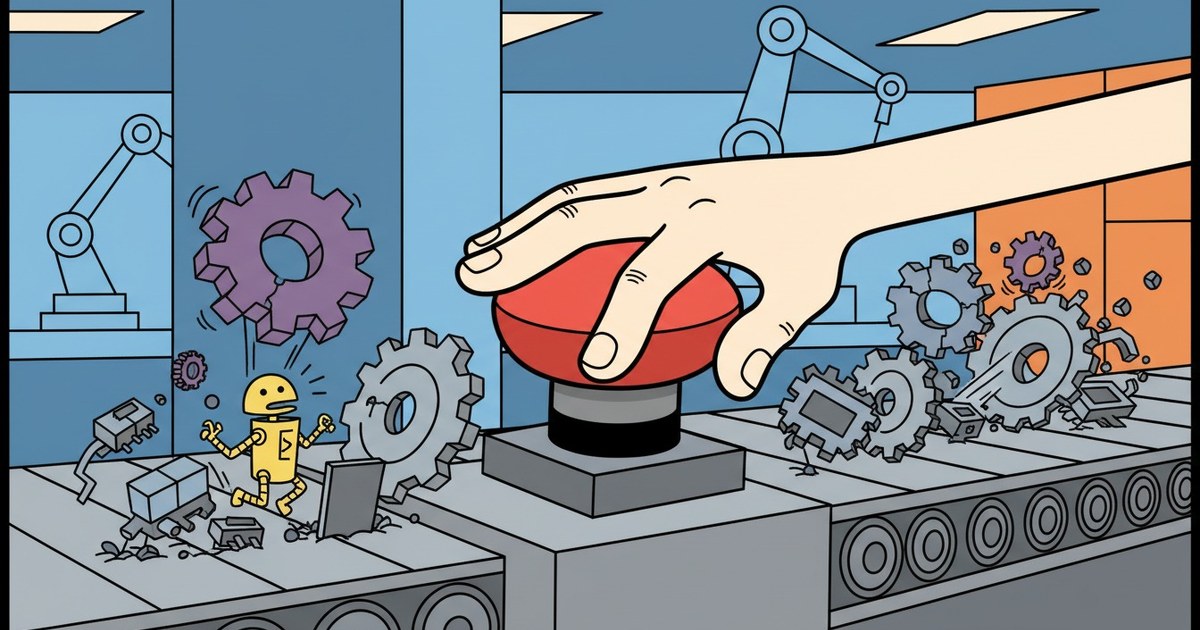
The kill-switch is not a single button. It is a layered set of deterministic controls: interrupt the session, revoke credentials and tool access, and roll back to a safe state. The architecture combines a component registry (AIBOM), automated scanning, perimeter control for Shadow AI, and this multi-layered stop mechanism.
Step 1: AIBOM in CI
Auto-generate an ML-BOM using CycloneDX (the ECMA-424 standard, 2nd ed., Dec 2025). The bill of materials must capture what the component is, where it came from, its version, license, and hash — for weights, datasets, system prompts, libraries, and also agents, MCP servers, and vector stores.
A manual registry goes stale immediately. Generate it in the pipeline only, as part of the CI workflow, so the AIBOM reflects exactly what is deployed.
Step 2: Scanning weights before deployment
Before any model artifact is deployed, run it through ModelScan or picklescan to detect embedded executable code.
model artifact → ModelScan/picklescan → [code inside?] ─yes→ block + alert
                                              │no
                       prefer safetensors ────┴→ verify hash/provenance → deploy
If the scan is clean, verify the hash and provenance, then deploy. Prefer the Safetensors format — it does not execute code on load. Safetensors has been under the PyTorch Foundation/Linux Foundation since April 2026.
Step 3: Blocking Shadow AI
Deploy a next-gen CASB/SWG (such as Netskope or Zscaler) to detect and block corporate traffic sent to unauthorized external AI endpoints. The sanctioned AI gateway is the only legal path to models.
A ban with no convenient legal alternative breeds Shadow AI. If the sanctioned path is slow or restrictive, employees will route around it. Provide a usable, approved gateway or accept that the perimeter will be bypassed.
Step 4: The kill-switch as external state
The kill-switch is implemented as a state machine, not an if statement in code. It is a flag in the policy engine or a feature flag that every service and agent is required to check before acting.
The layers of the kill-switch operate in sequence:
- Interrupt the current session or agent loop.
- Revoke short-lived credentials and tool access (MCP scopes, API keys).
- Roll back to a safe state — freeze unfinished actions.
Step 5: Least privilege for agents
An agent's tools must have minimal scopes, short-lived and revocable credentials, and a sandbox. If the kill-switch has to fire, least privilege ensures the blast radius of what the agent can do in the window before revocation is small.
Where it breaks
An untested kill-switch does not work. An unrehearsed "stop" fails at the moment of an incident — hence the 5% confidence figure. Regular chaos-drill agent stops are mandatory. If you have never run the kill-switch in a controlled failure scenario, you do not have a kill-switch.
Distributed agents. Stopping a swarm is harder than stopping a single process. You need a centralized revocation point, but that point is also a single point of failure. Balance the centralization against the resilience of the gateway.
AIBOM goes stale without CI auto-generation. The registry drifts from what is actually deployed the moment someone hotfixes a model or updates a prompt outside the pipeline.
CASB gets bypassed. Personal devices and networks outside the perimeter will always exist. Full control is unattainable — reduce the attack surface, do not expect to zero it out.
Poisoning stays hidden. A scanner catches executable code, not "logical" dataset poisoning. Backdoor triggers embedded in data require eval and red-team work to detect.
Safetensors is not a cure-all. It removes RCE on load, but it does not guarantee the weights themselves are clean. Behavioral backdoors remain.
Standards and mapping
- OWASP LLM: LLM03 (Supply Chain), LLM04 (Data & Model Poisoning), LLM06 (Excessive Agency).
- ISO/IEC 42001: Supplier, change, and incident management.
- NIST AI RMF: Manage (third-party components, incident response).
- EU AI Act: Art. 14 (oversight, kill-switch as part of it), Art. 15 (cybersecurity/robustness).
- CycloneDX / ECMA-424: The AIBOM format.
Maturity checklist
- L1: A list of models and dependencies exists; manual weight scanning.
- L2: An AIBOM (CycloneDX) is generated in CI; auto-scanning is active; CASB blocks Shadow AI; a kill-switch exists.
- L3: Regular kill-switch drills; least-privilege agents; weight provenance and hash verification; an incident runbook; Safetensors by default.
Lab and artifact
The lab generates a CycloneDX ML-BOM for the system (including the vector store and MCP servers), runs the weights through ModelScan to show a block on a pickle backdoor and a switch to Safetensors, configures the kill-switch as a policy flag, and runs a drill that stops an agentic branch with credential revocation. The lab also simulates a Shadow AI endpoint and a CASB block.
The resulting artifact is an AIBOM, a scan report, and a kill-switch test protocol — evidence of oversight capability.
If you cannot generate an AIBOM from your pipeline right now, and you have never executed a kill-switch drill against a live agent, you are relying on hope. The next time an agent picks up a poisoned model and starts acting on your infrastructure with live credentials, hope will not stop it.